Asia-Pacific Digital Twin Market Size and Insights – 2026 to 2033
Report ID : IL_12183 | Report Language's : En/Jp/Fr/De | Publisher : IL |
Format : 


What is the Market Size of the Asia-Pacific Digital Twin in 2026?
The Asia-Pacific Digital Twin Market Size in 2026 is estimated to be $1.80 Billion
What is the Growth Rate (CAGR) of Asia-Pacific Digital Twin Market?
The Asia-Pacific Digital Twin Market is expected to grow at 30.5% CAGR
What is the Market Size of the Asia-Pacific Digital Twin in 2033?
The Asia-Pacific Digital Twin Market Size in 2033 is estimated to be $11.32 Billion
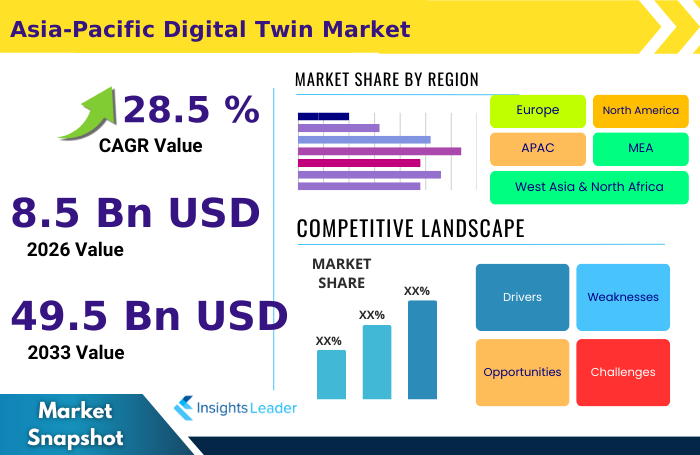
Report Snapshot
| Report Attributes | Report Details |
|---|---|
| Forecast Year | 2033 |
| CAGR | 30.5% |
| History Year | 2016-2024 |
| Market Size in 2026 | $1.80 Billion |
| Market Size in 2033 | $11.32 Billion |
What are DRO & Impact Forces of Asia-Pacific Digital Twin Market?
Drivers include rapid adoption of Industry 4.0 in manufacturing hubs (China, India, Japan), significant government investments in smart cities and infrastructure modernization, and the increasing complexity of supply chains requiring real-time simulation. Restraints involve high initial capital expenditure, data security concerns associated with sensitive operational data, and a persistent shortage of skilled professionals capable of developing and managing sophisticated twin platforms.
What is Impact of US Tariffs on Asia-Pacific Digital Twin Market?
U.S. tariffs primarily affect the pricing and availability of crucial hardware components, such as high-performance sensors, IoT devices, and specialized computing infrastructure sourced from key APAC regions. This has prompted market players to diversify supply chains, accelerating regional sourcing strategies, but also introduces short-term cost volatility for implementations requiring specialized equipment subject to trade restrictions.
How is AI currently impacting Asia-Pacific Digital Twin Market?
AI is fundamentally enhancing the operational realism and predictive capabilities of digital twins by facilitating automated anomaly detection, enabling sophisticated predictive maintenance schedules, and running complex scenario planning. Machine learning algorithms process vast streams of real-time sensor data, moving digital twins beyond mere visualization to become essential, autonomous decision-support tools, particularly in complex sectors like energy and high-tech manufacturing.
Asia-Pacific Digital Twin Market Research Report – Table of Contents
1. Executive Summary
2. Introduction & Research Objectives
3. Scope of the Study
4. Research Methodology of Asia-Pacific Digital Twin Market
5. Asia-Pacific Digital Twin Market Overview & Industry Background
6. Asia-Pacific Digital Twin Market Size & Forecast Analysis
7. Asia-Pacific Digital Twin Market Segmentation Analysis
8. Competitive Landscape
9. Consumer Behavior & Demand Analysis
10. Pricing & Cost Structure Analysis
11. Asia-Pacific Digital Twin Market Drivers, Challenges & Risks
12. Regulatory & Policy Framework
13. Technology & Innovation Impact
14. Strategic Insights & Recommendations
15. Conclusion & Future Outlook
For more queries, kindly contact [email protected]