Asia-Pacific Real Time Payments Market Size and Insights – 2026 to 2033
Report ID : IL_13377 | Report Language's : En/Jp/Fr/De | Publisher : IL |
Format : 


What is the Market Size of the Asia-Pacific Real Time Payments in 2026?
The Asia-Pacific Real Time Payments Market Size in 2026 is estimated to be USD 4.2 Billion
What is the Growth Rate (CAGR) of Asia-Pacific Real Time Payments Market?
The Asia-Pacific Real Time Payments Market is expected to grow at 18.5% CAGR
What is the Market Size of the Asia-Pacific Real Time Payments in 2033?
The Asia-Pacific Real Time Payments Market Size in 2033 is estimated to be USD 16.5 Billion
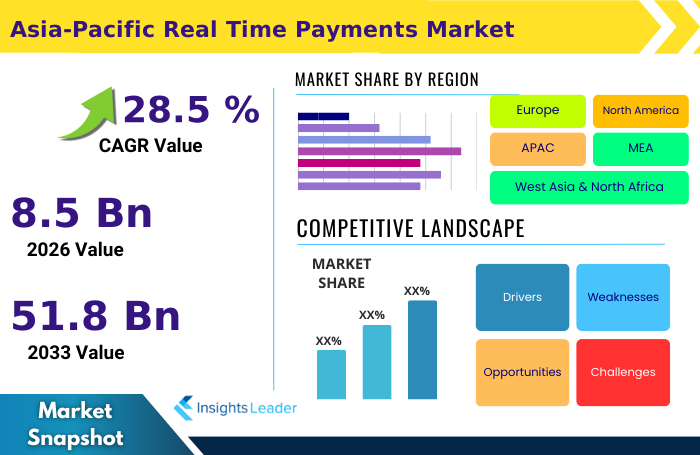
Report Snapshot
| Report Attributes | Report Details |
|---|---|
| Forecast Year | 2033 |
| CAGR | 18.5% |
| History Year | 2016-2024 |
| Market Size in 2026 | 4.2 Billion USD |
| Market Size in 2033 | 16.5 Billion USD |
What are DRO & Impact Forces of Asia-Pacific Real Time Payments Market?
The key Determinants, Restraints, and Opportunities (DRO) shape market dynamics. Determinants include rising smartphone penetration, robust regulatory support for instant settlement, and increasing demand for seamless e-commerce transactions across the region. Restraints often involve challenges related to cross-border interoperability between diverse payment schemes, cybersecurity vulnerabilities, and the complexity of harmonizing anti-money laundering (AML) regulations across APAC. Opportunities are largely driven by the expansion of B2B real-time payment use cases, integration with emerging Decentralized Finance (DeFi) technologies, and the penetration into underserved rural populations, collectively driving substantial market transformation and competitive innovation.
What is Impact of US Tariffs on Asia-Pacific Real Time Payments Market?
While the Asia-Pacific Real-Time Payments Market is predominantly focused on domestic transactions and consumer adoption, the ongoing US tariffs indirectly influence the market through macroeconomic channels. Increased trade tensions and tariffs can lead to volatility in exchange rates and a slowdown in foreign direct investment (FDI) aimed at the APAC manufacturing and supply chain sectors. This external pressure may marginally impact the volume and value of Business-to-Business (B2B) real-time cross-border payments associated with international trade flows, although the core growth trajectory driven by domestic financial inclusion remains strong.
How is AI currently impacting Asia-Pacific Real Time Payments Market?
AI is fundamentally transforming industries globally by enabling sophisticated automation, advanced predictive analytics, and highly personalized customer experiences across sectors. In financial services, AI dramatically enhances fraud detection capabilities, optimizes credit risk modeling, and powers hyper-efficient algorithmic trading systems, reducing operational latency. Across manufacturing and logistics, AI optimizes complex supply chain planning, facilitates predictive maintenance of machinery, and supports the deployment of autonomous operational systems, leading to substantial gains in efficiency and operational uptime worldwide.
Asia-Pacific Real Time Payments Market Research Report – Table of Contents
1. Executive Summary
2. Introduction & Research Objectives
3. Scope of the Study
4. Research Methodology of Asia-Pacific Real Time Payments Market
5. Asia-Pacific Real Time Payments Market Overview & Industry Background
6. Asia-Pacific Real Time Payments Market Size & Forecast Analysis
7. Asia-Pacific Real Time Payments Market Segmentation Analysis
8. Competitive Landscape
9. Consumer Behavior & Demand Analysis
10. Pricing & Cost Structure Analysis
11. Asia-Pacific Real Time Payments Market Drivers, Challenges & Risks
12. Regulatory & Policy Framework
13. Technology & Innovation Impact
14. Strategic Insights & Recommendations
15. Conclusion & Future Outlook
For more queries, kindly contact [email protected]