Australia Biological Microscope Market Size and Insights – 2026 to 2033
Report ID : IL_6743 | Report Language's : En/Jp/Fr/De | Publisher : IL |
Format : 


What is the Market Size of the Australia Biological Microscope in 2026?
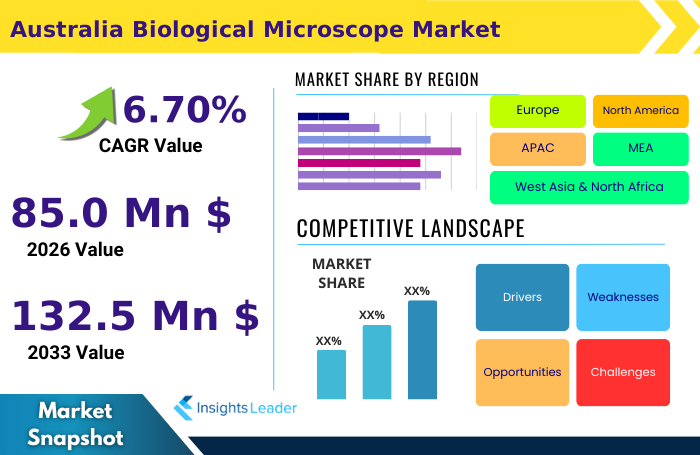
The Australia Biological Microscope Market Size in 2026 is estimated to be USD 85.0 Million
What is the Growth Rate (CAGR) of Australia Biological Microscope Market?
The Australia Biological Microscope Market is expected to grow at 6.7% CAGR
What is the Market Size of the Australia Biological Microscope in 2033?
The Australia Biological Microscope Market Size in 2033 is estimated to be USD 132.5 Million
What are DRO and Impact Forces of Australia Biological Microscope Market?
DRO refers to Drivers, Restraints, and Opportunities—the critical dynamics shaping market growth. Drivers include increasing investment in life science research and governmental initiatives supporting advanced diagnostics. Restraints typically involve the high initial capital expenditure required for sophisticated digital and confocal microscope systems. Opportunities are centered on integrating advanced imaging technologies and automated analysis capabilities into standard laboratory equipment, enhancing research efficiency across oncology and microbiology.
What is Impact of U.S. Tariffs on Australia Biological Microscope Market?
The primary impact of US tariffs on the Australian biological microscope market is indirect, affecting the global supply chain, particularly for high-end components sourced from key manufacturing regions. This friction can lead to increased procurement costs for Australian research institutions and universities due to global price volatility and extended lead times for highly specialized imported microscope parts. Local distributors must navigate these complexities, often resulting in slightly higher pricing for end-users.
How is AI currently impacting Australia Biological Microscope Market?
AI is fundamentally reshaping operational efficiencies by automating complex processes, improving predictive modeling, and enhancing data throughput across diverse sectors. In the scientific instrument industry, specifically, AI accelerates image analysis, enables automated cell counting, and provides sophisticated pattern recognition capabilities for high-content screening and disease diagnostics, drastically reducing the time required for critical biological discoveries worldwide.