Belgium Carbon Credits Market Size and Insights – 2026 to 2033
Report ID : IL_6706 | Report Language's : En/Jp/Fr/De | Publisher : IL |
Format : 



What is the Market Size of the Belgium Carbon Credits in 2026?
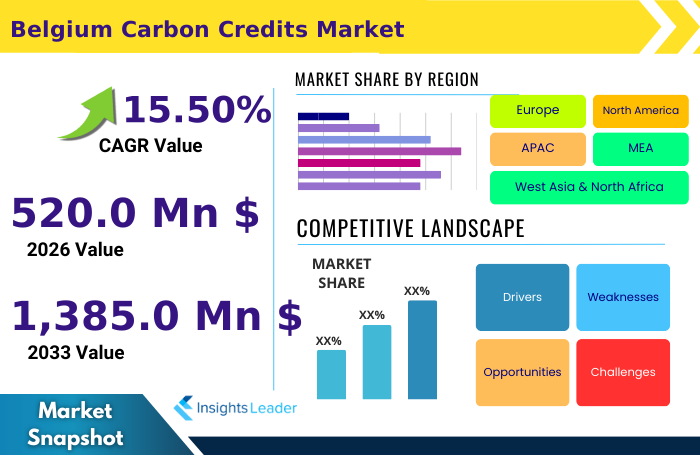
The Belgium Carbon Credits Market Size in 2026 is estimated to be $520.0 Million
What is the Growth Rate (CAGR) of Belgium Carbon Credits Market?
The Belgium Carbon Credits Market is expected to grow at 15.5% CAGR
What is the Market Size of the Belgium Carbon Credits in 2033?
The Belgium Carbon Credits Market Size in 2033 is estimated to be $1,385.0 Million
What are DRO and Impact Forces of Belgium Carbon Credits Market?
DRO refers to Drivers, Restraints, and Opportunities, the foundational elements shaping market dynamics. Drivers, such as stringent EU climate targets and corporate decarbonization commitments, propel demand for carbon credits. Restraints include price volatility and the potential for ‘greenwashing’ concerns impacting voluntary market integrity. Opportunities arise through technological innovation in carbon capture and storage (CCS) and the expansion of the compliance market scope under the EU ETS (Emissions Trading System). These elements collectively determine the trajectory and stability of the carbon credits market in Belgium.
What is Impact of U.S. Tariffs on Belgium Carbon Credits Market?
While direct US tariffs on Belgian carbon credits are non-existent, the broader geopolitical trade tensions and the potential introduction of mechanisms like the EU’s Carbon Border Adjustment Mechanism (CBAM), which acts similarly to a tariff, significantly influence market competitiveness. High tariffs on carbon-intensive exports entering the US could pressure Belgian manufacturing sectors to accelerate emissions reduction or purchase more credits to remain competitive, potentially boosting demand in the localized market. Conversely, US regulatory shifts could affect global demand benchmarks.
How is AI currently impacting Belgium Carbon Credits Market?
Artificial Intelligence is revolutionizing industries globally by optimizing operational efficiencies, enhancing predictive analytics for supply chain management, and accelerating research and development. In the climate sector, AI is crucial for modeling complex emission scenarios, optimizing energy grid management, and improving the monitoring and verification of carbon sequestration projects, thereby enhancing the integrity and efficacy of carbon credit markets. This integration of AI drives significant productivity gains and lowers the administrative overhead associated with compliance.