South Africa Carbon Credits Market Size and Insights – 2026 to 2033
Report ID : IL_5906 | Report Language's : En/Jp/Fr/De | Publisher : IL |
Format : 


What is the Market Size of the South Africa Carbon Credits in 2026?
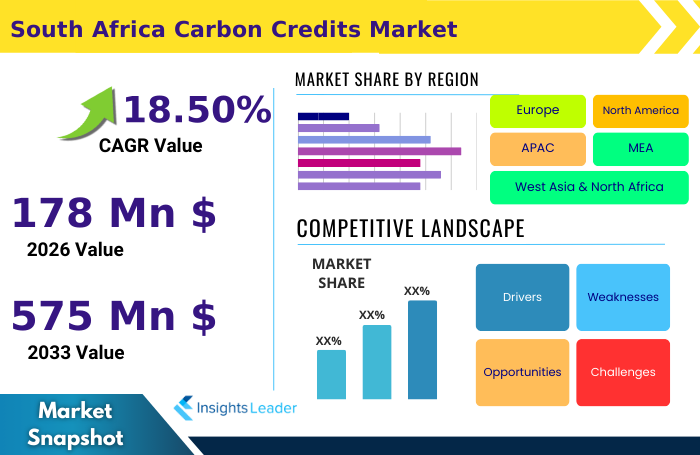
The South Africa Carbon Credits Market Size in 2026 is estimated to be $178 Million
What is the Growth Rate (CAGR) of South Africa Carbon Credits Market?
The South Africa Carbon Credits Market is expected to grow at 18.5% CAGR
What is the Market Size of the South Africa Carbon Credits in 2033?
The South Africa Carbon Credits Market Size in 2033 is estimated to be $575 Million
What are DRO and Impact Forces of South Africa Carbon Credits Market?
DRO stands for Drivers, Restraints, and Opportunities. Drivers include stringent domestic carbon tax policies and rising voluntary corporate commitments to net-zero targets. Restraints involve the lack of standardized regulatory frameworks across Africa and high costs associated with rigorous verification methodologies. Opportunities are centered on developing large-scale nature-based solutions and attracting international climate finance through Article 6 mechanisms.
What is Impact of U.S. Tariffs on South Africa Carbon Credits Market?
While direct US tariffs on carbon credits are not common, the introduction of potential carbon-based trade adjustments (similar to the EU’s CBAM) could significantly impact South African exporters. If US import duties are linked to the carbon intensity of goods, local industries will face strong pressure to decarbonize production. This necessity would increase the domestic demand for and valuation of South African carbon credits as companies seek compliance and competitive advantage in global markets.
How is AI currently impacting South Africa Carbon Credits Market?
AI is transforming global industry operations by providing advanced tools for predictive maintenance, optimizing supply chain logistics for efficiency, and significantly enhancing energy management systems. Specifically, in climate action, AI algorithms are crucial for automating the Monitoring, Reporting, and Verification (MRV) of carbon reduction projects and improving the accuracy of satellite-based monitoring for large afforestation schemes. This automation reduces verification costs and improves market integrity.