Italy Healthcare Interoperability Solutions Market Size and Insights – 2026 to 2033
Report ID : IL_6366 | Report Language's : En/Jp/Fr/De | Publisher : IL |
Format : 


What is the Market Size of the Italy Healthcare Interoperability Solutions in 2026?
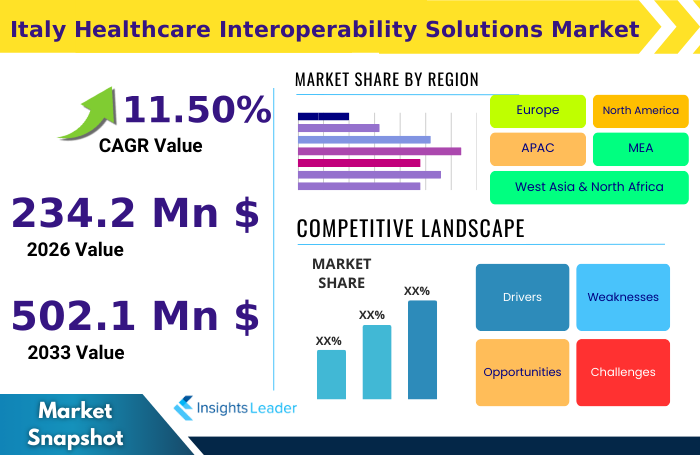
The Italy Healthcare Interoperability Solutions Market Size in 2026 is estimated to be $234.2 Million
What is the Growth Rate (CAGR) of Italy Healthcare Interoperability Solutions Market?
The Italy Healthcare Interoperability Solutions Market is expected to grow at 11.5% CAGR
What is the Market Size of the Italy Healthcare Interoperability Solutions in 2033?
The Italy Healthcare Interoperability Solutions Market Size in 2033 is estimated to be $502.1 Million
What are DRO and Impact Forces of Italy Healthcare Interoperability Solutions Market?
DRO (Drivers, Restraints, and Opportunities) analyze the core dynamics influencing market expansion. Drivers include government mandates for digital health integration and increased adoption of Electronic Health Records (EHRs). Restraints often involve high initial implementation costs and legacy system incompatibility. Opportunities are concentrated in cloud-based solutions and regional data sharing projects (e.g., FSE 2.0).
What is Impact of U.S. Tariffs on Italy Healthcare Interoperability Solutions Market?
The direct impact of US tariffs on the Italian healthcare interoperability market is generally minimal, as most solutions involve software and local service deployment rather than high-volume cross-border hardware trade affected by typical tariffs. However, increased global trade instability resulting from tariffs can indirectly affect pricing for critical underlying hardware components (servers, storage) sourced internationally, potentially impacting vendor profitability and project costs.
How is AI currently impacting Italy Healthcare Interoperability Solutions Market?
Artificial Intelligence is transforming global industries by automating complex data processing, enhancing predictive analytics, and optimizing operational efficiencies. In healthcare, AI aids in rapid diagnostic support, personalized medicine development, and streamlining administrative interoperability processes by standardizing and normalizing disparate data sets at scale.