Japan Industrial Ethernet Market Size and Insights – 2026 to 2033
Report ID : IL_3109 | Report Language's : En/Jp/Fr/De | Publisher : IL |
Format : 


What is the Market Size of the Japan Industrial Ethernet in 2026?
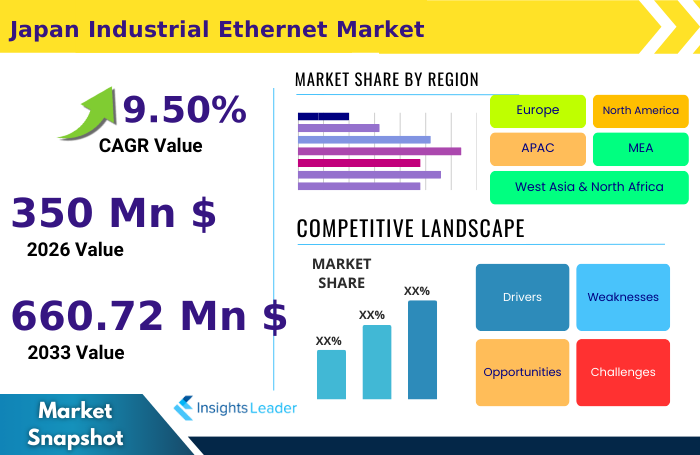
The Japan Industrial Ethernet Market Size in 2026 is estimated to be $350 Million USD
What is the Growth Rate (CAGR) of Japan Industrial Ethernet Market?
The Japan Industrial Ethernet Market is expected to grow at CAGR 9.5%
What is the Market Size of the Japan Industrial Ethernet in 2033?
The Japan Industrial Ethernet Market Size in 2033 is estimated to be $660.72 Million USD
What are DRO & Impact Forces?
Drivers, Restraints, and Opportunities (DRO) are strategic forces dictating market trajectory. Drivers include the push for smart factory implementation and digital transformation initiatives in Japanese manufacturing. Restraints typically involve the high initial investment required for migration from legacy fieldbus systems and the necessity for specialized operational technology (OT) expertise. Opportunities center around the integration of 5G infrastructure and Time-Sensitive Networking (TSN) standards.
What is Impact of US tariffs?
While Japan is not the primary target of US tariffs, the geopolitical dynamic significantly affects global electronics and semiconductor supply chains. Tariffs increase the procurement cost of key Industrial Ethernet hardware components, such as chipsets, connectors, and switches, sourced from affected regions. This impact leads to potential marginal delays in project deployments and increased hardware pricing for Japanese integrators and end-users, affecting budget allocations for capital expenditure.
How is AI currently impacting industries globally?
Artificial Intelligence is fundamentally reshaping industrial operations by enabling predictive maintenance, optimizing supply chain logistics, and driving autonomous quality control. AI relies heavily on the constant, high-speed data flow facilitated by Industrial Ethernet, leveraging massive datasets from interconnected machinery to derive actionable insights, leading to enhanced efficiency, reduced downtime, and the eventual implementation of completely autonomous manufacturing cells worldwide.