Norway Carbon Credits Market Size and Insights – 2026 to 2033
Report ID : IL_6066 | Report Language's : En/Jp/Fr/De | Publisher : IL |
Format : 



What is the Market Size of the Norway Carbon Credits in 2026?
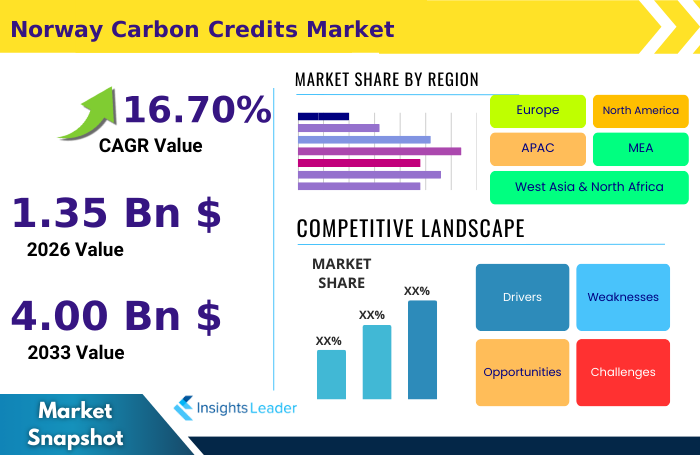
The Norway Carbon Credits Market Size in 2026 is estimated to be USD 1.35 Billion
What is the Growth Rate (CAGR) of Norway Carbon Credits Market?
The Norway Carbon Credits Market is expected to grow at 16.7% CAGR
What is the Market Size of the Norway Carbon Credits in 2033?
The Norway Carbon Credits Market Size in 2033 is estimated to be USD 4.00 Billion
What are DRO and Impact Forces of Norway Carbon Credits Market?
Drivers include Norway’s stringent national climate targets and high integration into the EU Emissions Trading System (ETS). Restraints involve the inherent volatility of carbon pricing mechanisms and the limited local supply of certified high-quality carbon removal credits (especially nature-based solutions). Opportunities arise from advancements in Carbon Capture and Storage (CCS) technology and the expansion of blue carbon initiatives within Norwegian coastal regions.
What is Impact of U.S. Tariffs on Norway Carbon Credits Market?
The direct impact of US tariffs on the regulated Norwegian carbon credits market, which is predominantly driven by domestic and EU compliance obligations, is assessed as minimal. However, indirect impacts may manifest through global supply chain adjustments; if tariffs lead to slower industrial production or reduced corporate profitability worldwide, the demand for voluntary carbon offsets purchased by multinational corporations operating in Norway could temporarily soften. The compliance market structure remains largely insulated from direct US trade policy.
How is AI currently impacting Norway Carbon Credits Market?
AI is fundamentally transforming global industries by optimizing complex operational processes, particularly in energy management and logistics, leading to significant efficiency gains and verifiable emission reductions. Furthermore, AI algorithms are crucial for improving the precision of predictive modeling for emissions forecasting and accelerating the rigorous auditing and verification protocols required for high-integrity carbon credit projects worldwide, ensuring greater market transparency and trust.