South Africa Carbon Credits Market Size and Insights – 2026 to 2033
Report ID : IL_14919 | Report Language's : En/Jp/Fr/De | Publisher : IL |
Format : 



What is the Market Size of the South Africa Carbon Credits in 2026?
The South Africa Carbon Credits Market Size in 2026 is estimated to be $150 Million
What is the Growth Rate (CAGR) of South Africa Carbon Credits Market?
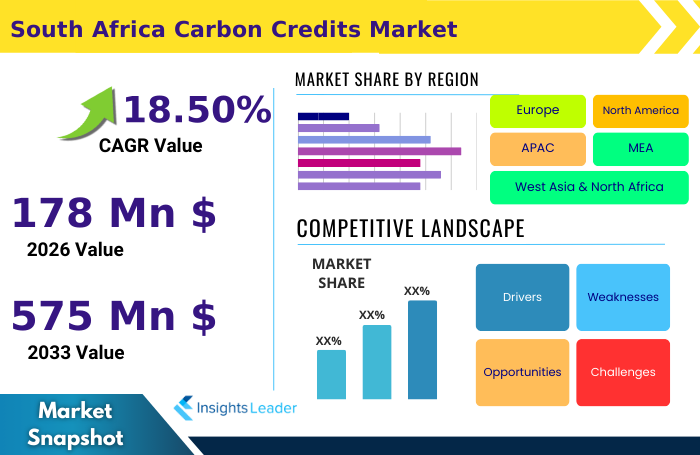
The South Africa Carbon Credits Market is expected to grow at 18.5% CAGR
What is the Market Size of the South Africa Carbon Credits in 2033?
The South Africa Carbon Credits Market Size in 2033 is estimated to be $480 Million
Report Snapshot
| Report Attributes | Report Details |
|---|---|
| Forecast Year | 2033 |
| CAGR | 18.5% |
| History Year | 2016-2024 |
| Market Size in 2026 | 150 Million USD |
| Market Size in 2033 | 480 Million USD |
What are DRO & Impact Forces of South Africa Carbon Credits Market?
Drivers include the mandatory national carbon tax, increasing corporate net-zero commitments, and high demand for quality offsets in voluntary markets. Restraints involve regulatory uncertainties regarding international linkages and high initial capital required for project development. Opportunities lie in expanding nature-based solutions and leveraging digital monitoring technologies.
What is Impact of US Tariffs on South Africa Carbon Credits Market?
The direct impact of standard U.S. trade tariffs on the price and volume of carbon credits traded as financial instruments is generally minimal, as they primarily target physical goods. However, if U.S. tariffs impede South African exports, they indirectly reduce operating margins for local businesses, potentially decreasing capital allocated for purchasing voluntary offsets or investing in emission reduction projects. Future global policies, such as the implementation of a Carbon Border Adjustment Mechanism (CBAM) by major economies, pose a more significant potential impact than existing bilateral tariffs.
How is AI currently impacting South Africa Carbon Credits Market?
AI significantly enhances the efficiency, integrity, and scalability of carbon credit projects by optimizing Measurement, Reporting, and Verification (MRV) processes. It allows for advanced satellite imagery analysis to track land-use changes and monitor project permanence in real-time, greatly reducing the costs associated with physical auditing. Furthermore, AI algorithms are used to accurately model baseline emissions and predict the viability and potential yield of various sequestration methodologies, thereby fostering crucial investor confidence.
South Africa Carbon Credits Market Research Report – Table of Contents
1. Executive Summary
2. Introduction & Research Objectives
3. Scope of the Study
4. Research Methodology of South Africa Carbon Credits Market
5. South Africa Carbon Credits Market Overview & Industry Background
6. South Africa Carbon Credits Market Size & Forecast Analysis
7. South Africa Carbon Credits Market Segmentation Analysis
8. Competitive Landscape
9. Consumer Behavior & Demand Analysis
10. Pricing & Cost Structure Analysis
11. South Africa Carbon Credits Market Drivers, Challenges & Risks
12. Regulatory & Policy Framework
13. Technology & Innovation Impact
14. Strategic Insights & Recommendations
15. Conclusion & Future Outlook
For more queries, kindly contact [email protected]