Switzerland Biological Microscope Market Size and Insights – 2026 to 2033
Report ID : IL_5743 | Report Language's : En/Jp/Fr/De | Publisher : IL |
Format : 


What is the Market Size of the Switzerland Biological Microscope in 2026?
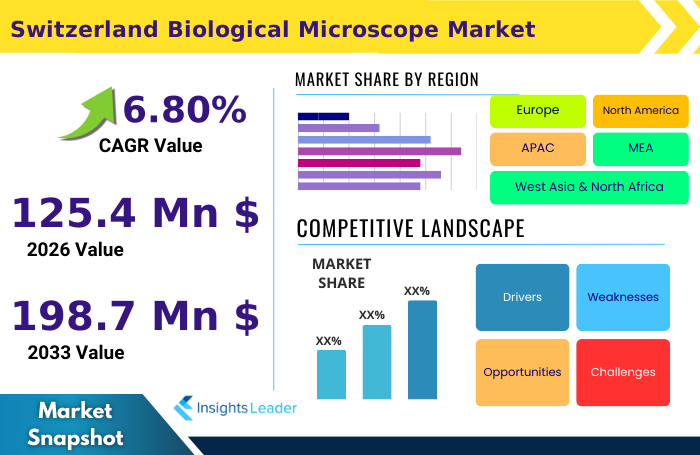
The Switzerland Biological Microscope Market Size in 2026 is estimated to be USD 125.4 Million
What is the Growth Rate (CAGR) of Switzerland Biological Microscope Market?
The Switzerland Biological Microscope Market is expected to grow at 6.8% CAGR
What is the Market Size of the Switzerland Biological Microscope in 2033?
The Switzerland Biological Microscope Market Size in 2033 is estimated to be USD 198.7 Million
What are DRO and Impact Forces of Switzerland Biological Microscope Market?
DRO stands for Drivers, Restraints, and Opportunities, which constitute the core mechanisms shaping the Switzerland Biological Microscope market dynamics. Drivers include robust funding for life sciences research and the presence of world-leading pharmaceutical companies and academic institutions demanding high-resolution imaging solutions. Restraints often involve the high initial capital expenditure required for advanced confocal and super-resolution systems. Opportunities focus on the adoption of digital pathology and tele-microscopy in remote settings.
What is Impact of U.S. Tariffs on Switzerland Biological Microscope Market?
The indirect impact of US tariffs is primarily felt through supply chain disruptions and increased cost structures for global manufacturers operating in or supplying the Swiss market. While Switzerland maintains favorable trade agreements, tariffs imposed by the US on complex optical components or electronics sourced from Asia can elevate the manufacturing costs of key global suppliers (like Leica, Zeiss, Olympus) of microscopy equipment. This leads to marginally higher procurement prices for Swiss academic and clinical end-users, affecting budgeting cycles.
How is AI currently impacting Switzerland Biological Microscope Market?
AI is fundamentally transforming global industries by accelerating data processing, automating routine tasks, and enabling predictive modeling, particularly evident in the biotechnology and diagnostic sectors. In microscopy, AI algorithms facilitate rapid and accurate image segmentation, feature extraction, and automated cellular classification, drastically reducing the time required for pathological diagnoses and high-throughput drug screening experiments, thereby speeding up scientific discovery and clinical workflows worldwide.