Asia-Pacific Mobile Mapping Market Size and Insights – 2026 to 2033
Report ID : IL_12170 | Report Language's : En/Jp/Fr/De | Publisher : IL |
Format : 


What is the Market Size of the Asia-Pacific Mobile Mapping in 2026?
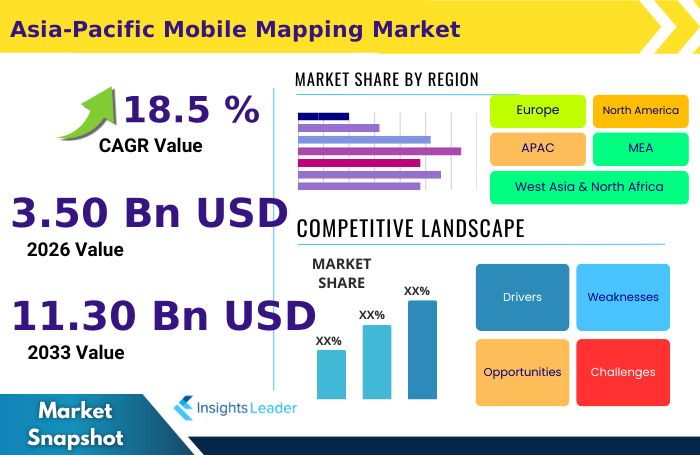
The Asia-Pacific Mobile Mapping Market Size in 2026 is estimated to be USD 3.50 Billion
What is the Growth Rate (CAGR) of Asia-Pacific Mobile Mapping Market?
The Asia-Pacific Mobile Mapping Market is expected to grow at 18.5% CAGR
What is the Market Size of the Asia-Pacific Mobile Mapping in 2033?
The Asia-Pacific Mobile Mapping Market Size in 2033 is estimated to be USD 11.30 Billion
Report Snapshot
| Report Attributes | Report Details |
|---|---|
| Forecast Year | 2033 |
| CAGR | 18.5% |
| History Year | 2016-2024 |
| Market Size in 2026 | USD 3.50 Billion |
| Market Size in 2033 | USD 11.30 Billion |
What are DRO & Impact Forces of Asia-Pacific Mobile Mapping Market?
Drivers include massive infrastructure development and the rapid adoption of smart city initiatives across major economies like China and India, fueling demand for high-accuracy geospatial data. Restraints primarily involve the high initial cost of specialized LiDAR and sensor hardware, alongside complexities in data processing and standardization across diverse regional regulations. Opportunities are centered on autonomous vehicle development and digital twin creation for urban planning and asset management.
What is Impact of US Tariffs on Asia-Pacific Mobile Mapping Market?
U.S. tariffs exert an indirect impact, primarily affecting the supply chain for key components such as advanced GNSS receivers, LiDAR units, and high-performance Inertial Measurement Units (IMUs). This can lead to increased procurement costs for system integrators in the APAC region, forcing greater reliance on European or domestic suppliers, potentially affecting system integration costs and deployment timelines for large-scale projects.
How is AI currently impacting Asia-Pacific Mobile Mapping Market?
AI is fundamentally transforming mobile mapping by automating the complex and time-consuming processes of data classification, feature extraction, and quality control. Machine learning algorithms enable instantaneous identification of assets (e.g., street furniture, utility poles, road conditions) from point cloud and imagery data, drastically improving operational efficiency and reducing human error in the creation of comprehensive 3D models.
Asia-Pacific Mobile Mapping Market Research Report – Table of Contents
1. Executive Summary
2. Introduction & Research Objectives
3. Scope of the Study
4. Research Methodology of Asia-Pacific Mobile Mapping Market
5. Asia-Pacific Mobile Mapping Market Overview & Industry Background
6. Asia-Pacific Mobile Mapping Market Size & Forecast Analysis
7. Asia-Pacific Mobile Mapping Market Segmentation Analysis
8. Competitive Landscape
9. Consumer Behavior & Demand Analysis
10. Pricing & Cost Structure Analysis
11. Asia-Pacific Mobile Mapping Market Drivers, Challenges & Risks
12. Regulatory & Policy Framework
13. Technology & Innovation Impact
14. Strategic Insights & Recommendations
15. Conclusion & Future Outlook
For more queries, kindly contact [email protected]