Asia-Pacific Transcatheter Embolization and Occlusion Market Size and Insights – 2026 to 2033
Report ID : IL_18194 | Report Language's : En/Jp/Fr/De | Publisher : IL |
Format : 


What is the Market Size of the Asia-Pacific Transcatheter Embolization and Occlusion in 2026?
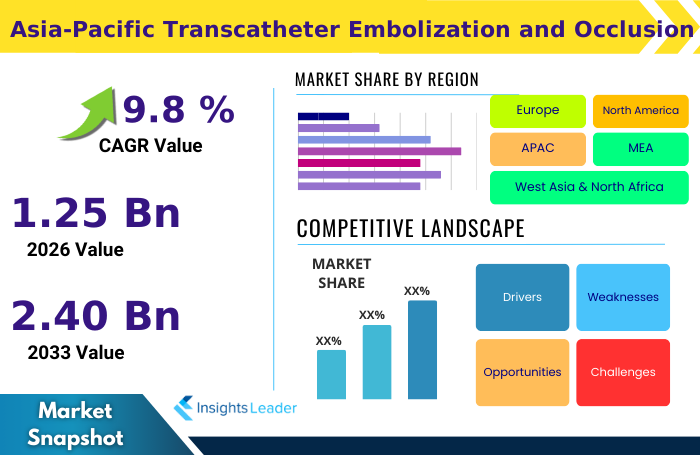
The Asia-Pacific Transcatheter Embolization and Occlusion Market Size in 2026 is estimated to be USD 1.25 Billion
What is the Growth Rate (CAGR) of Asia-Pacific Transcatheter Embolization and Occlusion Market?
The Asia-Pacific Transcatheter Embolization and Occlusion Market is expected to grow at 9.8% CAGR
What is the Market Size of the Asia-Pacific Transcatheter Embolization and Occlusion in 2033?
The Asia-Pacific Transcatheter Embolization and Occlusion Market Size in 2033 is estimated to be USD 2.40 Billion
Report Snapshot
| Report Attributes | Report Details |
|---|---|
| Forecast Year | 2033 |
| CAGR | 9.8% |
| History Year | 2016-2024 |
| Market Size in 2026 | 1.25 Billion USD |
| Market Size in 2033 | 2.40 Billion USD |
What are DRO and Impact Forces of Asia-Pacific Transcatheter Embolization and Occlusion Market?
Drivers include the increasing prevalence of cardiovascular diseases, neurovascular disorders, and hepatocellular carcinoma across the geriatric population in APAC. Opportunities arise from technological advancements in materials science, focusing on bioresorbable and enhanced coil designs, coupled with expansion into emerging economies like India and Vietnam, which are rapidly developing their healthcare infrastructure. Restraints often center on stringent regulatory approval processes in countries like China and Japan, alongside high procedure costs and limited skilled interventional specialists in rural areas.
What is Impact of U.S. Tariffs on Asia-Pacific Transcatheter Embolization and Occlusion Market?
While U.S. tariffs do not directly impact the consumption rates within the Asia-Pacific region, they significantly affect global supply chain dynamics for critical raw materials and intermediate components sourced internationally. This leads to increased manufacturing costs for devices produced by multinational corporations operating within the APAC market, potentially necessitating price adjustments. Furthermore, tariffs influence investment strategies, encouraging regional players to establish localized manufacturing hubs to mitigate cross-border trade risks and accelerate market entry.
How is AI currently impacting Asia-Pacific Transcatheter Embolization and Occlusion Market?
AI is primarily impacting the market through enhanced diagnostic accuracy and procedural efficiency, specifically in medical imaging analysis (CT, MRI) to precisely locate and characterize target vasculature for embolization. It facilitates robotic navigation systems, optimizing catheter manipulation and reducing procedure time and radiation exposure for both patients and clinicians. Additionally, AI algorithms are being employed in personalized treatment planning, predicting outcomes, and managing procedural workflow for complex interventions.
Asia-Pacific Transcatheter Embolization and Occlusion Market Research Report – Table of Contents
1. Executive Summary
2. Introduction & Research Objectives
3. Scope of the Study
4. Research Methodology of Asia-Pacific Transcatheter Embolization and Occlusion Market
5. Asia-Pacific Transcatheter Embolization and Occlusion Market Overview & Industry Background
6. Asia-Pacific Transcatheter Embolization and Occlusion Market Size & Forecast Analysis
7. Asia-Pacific Transcatheter Embolization and Occlusion Market Segmentation Analysis
8. Competitive Landscape
9. Consumer Behavior & Demand Analysis
10. Pricing & Cost Structure Analysis
11. Asia-Pacific Transcatheter Embolization and Occlusion Market Drivers, Challenges & Risks
12. Regulatory & Policy Framework
13. Technology & Innovation Impact
14. Strategic Insights & Recommendations
15. Conclusion & Future Outlook
For more queries, kindly contact [email protected]