Australia Construction Machinery Market Size and Insights – 2026 to 2033
Report ID : IL_18152 | Report Language's : En/Jp/Fr/De | Publisher : IL |
Format : 


What is the Market Size of the Australia Construction Machinery in 2026?
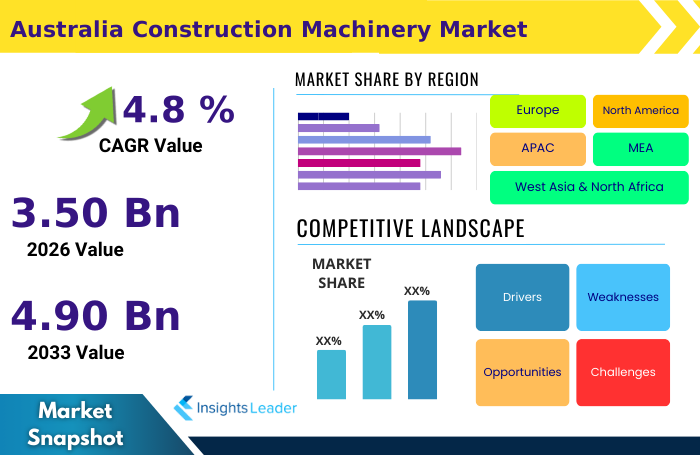
The Australia Construction Machinery Market Size in 2026 is estimated to be USD 3.50 Billion
What is the Growth Rate (CAGR) of Australia Construction Machinery Market?
The Australia Construction Machinery Market is expected to grow at 4.8% CAGR
What is the Market Size of the Australia Construction Machinery in 2033?
The Australia Construction Machinery Market Size in 2033 is estimated to be USD 4.90 Billion
Report Snapshot
| Report Attributes | Report Details |
|---|---|
| Forecast Year | 2033 |
| CAGR | 4.8% |
| History Year | 2016-2024 |
| Market Size in 2026 | 3.50 Billion USD |
| Market Size in 2033 | 4.90 Billion USD |
What are DRO and Impact Forces of Australia Construction Machinery Market?
Drivers include significant public investment in major infrastructure projects, particularly in transport (road, rail) and renewable energy facilities, sustained demand from the robust mining sector, and the necessity for fleet replacement due to stringent emission standards.Restraints are primarily linked to the scarcity of skilled heavy machinery operators and technicians, persistent supply chain delays for specialized components, and the operational risks associated with fluctuating commodity prices that influence large resource projects.Opportunities lie in the accelerated adoption of electric and hybrid construction equipment driven by net-zero commitments, expansion of digital technologies for remote monitoring and efficiency, and specialization in machinery designed for harsh Australian operating environments.
What is Impact of U.S. Tariffs on Australia Construction Machinery Market?
While Australia generally maintains stable trade relations, U.S. tariffs, particularly those affecting steel and aluminum, can indirectly elevate the global price of raw materials used in machinery production, increasing input costs for international Original Equipment Manufacturers (OEMs).The primary impact is observed in the supply chain volatility for specific high-tech components sourced globally, including those used in sophisticated telematics and engine control units, which can cause delays and localized price increases for new equipment imports.Australian market prices for construction equipment are thus influenced by global trade tensions, often leading OEMs to recalibrate regional pricing strategies to absorb or pass on increased manufacturing costs arising from complex international trade policies.
How is AI currently impacting Australia Construction Machinery Market?
AI is fundamentally transforming operational efficiency and safety across Australian worksites, particularly in remote mining and major civil projects. Artificial intelligence models enable predictive maintenance by analyzing telematics data in real-time, drastically reducing unexpected downtime and optimizing service intervals for high-value assets. Furthermore, AI systems are crucial for enhancing job site safety through sophisticated object detection, collision avoidance, and automated site mapping, supporting the gradual rollout of fully autonomous heavy vehicles. This adoption is concentrated in large-scale operations where maximizing throughput and minimizing human error are critical objectives.
Australia Construction Machinery Market Research Report – Table of Contents
1. Executive Summary
2. Introduction & Research Objectives
3. Scope of the Study
4. Research Methodology of Australia Construction Machinery Market
5. Australia Construction Machinery Market Overview & Industry Background
6. Australia Construction Machinery Market Size & Forecast Analysis
7. Australia Construction Machinery Market Segmentation Analysis
8. Competitive Landscape
9. Consumer Behavior & Demand Analysis
10. Pricing & Cost Structure Analysis
11. Australia Construction Machinery Market Drivers, Challenges & Risks
12. Regulatory & Policy Framework
13. Technology & Innovation Impact
14. Strategic Insights & Recommendations
15. Conclusion & Future Outlook
For more queries, kindly contact [email protected]