Australia System On Module (SOM) Market Size and Insights – 2026 to 2033
Report ID : IL_3225 | Report Language's : En/Jp/Fr/De | Publisher : IL |
Format : 


What is the Market Size of the Australia System On Module (SOM) in 2026?
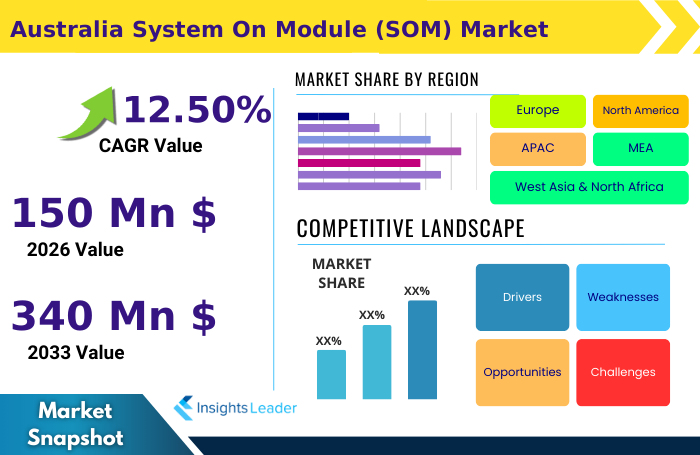
The Australia System On Module (SOM) Market Size in 2026 is estimated to be USD 150 Million
What is the Growth Rate (CAGR) of Australia System On Module (SOM) Market?
The Australia System On Module (SOM) Market is expected to grow at 12.5% CAGR
What is the Market Size of the Australia System On Module (SOM) in 2033?
The Australia System On Module (SOM) Market Size in 2033 is estimated to be USD 340 Million
What are DRO & Impact Forces?
DRO (Driving Restraints and Opportunities) outlines the core dynamics affecting market growth trajectory. Driving forces include rapid expansion of industrial IoT, accelerated 5G infrastructure deployment across Australia, and increasing demand for rapid prototyping in embedded systems development. Restraints encompass the complexity of integrating diverse operating systems and the competitive pressure from customized single-board computer (SBC) solutions. Opportunities are significantly driven by advancements in edge computing and the integration of AI capabilities into modular hardware designs.
What is Impact of US tariffs?
While Australia is not directly subject to US tariffs on specific goods, the geopolitical trade disputes have a notable indirect impact on the SOM market by disrupting global electronics supply chains. Manufacturers of critical components (processors, memory chips) face higher sourcing costs or delays, which translates into elevated Bill of Materials (BOM) for Australian SOM providers. This inflationary pressure can potentially reduce market adoption rates in price-sensitive application sectors, necessitating strategic inventory management and localized assembly optimization to mitigate risks.
How is AI currently impacting industries globally?
AI is fundamentally transforming global industries by facilitating automated decision-making and sophisticated data interpretation at the point of data acquisition (the edge), which is highly dependent on high-performance SOMs. Industries such as healthcare (diagnostic imaging), manufacturing (predictive maintenance), and security (video analytics) are adopting AI-enabled SOMs to execute complex algorithms efficiently. This integration is accelerating the demand for SOMs equipped with dedicated Neural Processing Units (NPUs) or powerful multicore GPUs, driving innovation and market segmentation based on processing throughput and power efficiency.