Europe Radar Sensors for IoT Market Size and Insights – 2026 to 2033
Report ID : IL_16701 | Report Language's : En/Jp/Fr/De | Publisher : IL |
Format : 


What is the Market Size of the Europe Radar Sensors for IoT in 2026?
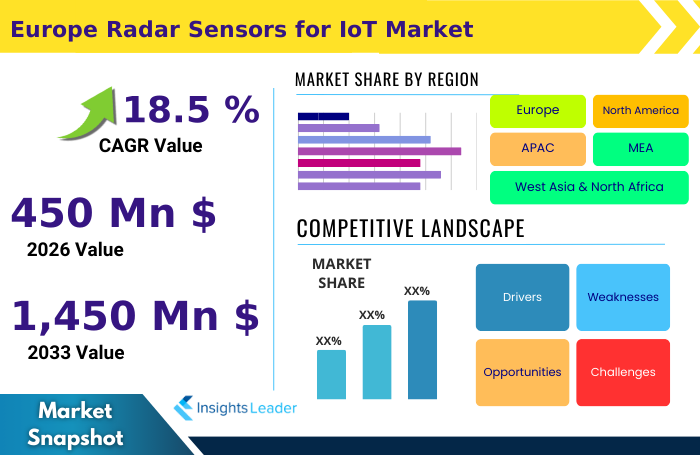
The Europe Radar Sensors for IoT Market Size in 2026 is estimated to be USD 450 Million
What is the Growth Rate (CAGR) of Europe Radar Sensors for IoT Market?
The Europe Radar Sensors for IoT Market is expected to grow at 18.5% CAGR
What is the Market Size of the Europe Radar Sensors for IoT in 2033?
The Europe Radar Sensors for IoT Market Size in 2033 is estimated to be USD 1,450 Million
Report Snapshot
| Report Attributes | Report Details |
|---|---|
| Forecast Year | 2033 |
| CAGR | 18.5% |
| History Year | 2016-2024 |
| Market Size in 2026 | 450 Million USD$ |
| Market Size in 2033 | 1,450 Million USD$ |
What are DRO & Impact Forces of Europe Radar Sensors for IoT Market?
Drivers: Miniaturization of sensor technology and the rapid deployment of 5G infrastructure significantly boost market growth. Increasing regulatory requirements for safety and security, particularly in automotive and industrial IoT applications, also drive adoption across Europe. The demand for highly accurate, non-invasive sensing solutions is paramount.
Restraints: High initial investment costs associated with advanced radar signal processing and integration complexity pose challenges. Furthermore, concerns regarding data privacy and standardization across diverse European countries can impede rapid, widespread market penetration.
Drivers: Increasing demand for high-precision object detection in smart cities and industrial automation; rapid advancements in 60 GHz and 77 GHz sensor chips.
Restraints: Spectrum allocation limitations and regulatory hurdles for unlicensed band operations; skilled labor shortage for complex sensor integration and maintenance.
What is Impact of US Tariffs on Europe Radar Sensors for IoT Market?
The direct impact of U.S. tariffs on the European radar sensors market is generally moderated, as a significant portion of manufacturing and core technology development occurs within Europe (Germany, Netherlands) or Asia. However, tariffs on key electronic components and computing hardware sourced via global supply chains often increase input costs for European manufacturers.
This indirect cost inflation can affect final pricing, potentially making European IoT solutions less competitive globally, although it simultaneously encourages the establishment of resilient, localized European supply chains for semiconductor components, bolstering regional economic stability in the long term.
U.S. tariffs cause supply chain friction and indirect cost increases for imported specialized semiconductor chips crucial for radar module assembly.
European manufacturers are incentivized to diversify sourcing away from tariff-affected regions, fostering regional component production and strategic autonomy.
Increased component costs due to tariffs marginally influence the bill of materials (BOM), potentially affecting pricing strategies in highly competitive sectors like automotive safety systems.
How is AI currently impacting Europe Radar Sensors for IoT Market?
Artificial Intelligence (AI) fundamentally transforms the Europe Radar Sensors for IoT Market by shifting focus from raw data collection to intelligent data interpretation. AI algorithms, particularly machine learning and deep learning, are integrated at the edge and in the cloud to drastically improve detection accuracy, reduce false positives, and enable sophisticated behavioral analysis in applications like elderly care monitoring and traffic management.
AI facilitates advanced signal processing techniques, allowing smaller, lower-power radar sensors to achieve performance previously restricted to larger systems. This integration enables predictive maintenance in industrial settings and highly adaptive autonomous driving features, driving next-generation sensor utilization across the continent.
AI enhances signal classification and noise reduction, significantly improving the reliability and precision of radar data in cluttered IoT environments.
Machine learning enables predictive analytics for condition monitoring, allowing industrial IoT sensors to forecast equipment failure with greater accuracy.
Edge AI processing minimizes latency and bandwidth usage by analyzing motion and presence data locally before transmitting critical insights to the cloud.
Europe Radar Sensors for IoT Market Research Report – Table of Contents
1. Executive Summary
2. Introduction & Research Objectives
3. Scope of the Study
4. Research Methodology of Europe Radar Sensors for IoT Market
5. Europe Radar Sensors for IoT Market Overview & Industry Background
6. Europe Radar Sensors for IoT Market Size & Forecast Analysis
7. Europe Radar Sensors for IoT Market Segmentation Analysis
8. Competitive Landscape
9. Consumer Behavior & Demand Analysis
10. Pricing & Cost Structure Analysis
11. Europe Radar Sensors for IoT Market Drivers, Challenges & Risks
12. Regulatory & Policy Framework
13. Technology & Innovation Impact
14. Strategic Insights & Recommendations
15. Conclusion & Future Outlook
For more queries, kindly contact [email protected]