France Breast Biopsy Devices Market Size and Insights – 2026 to 2033
Report ID : IL_6454 | Report Language's : En/Jp/Fr/De | Publisher : IL |
Format : 


What is the Market Size of the France Breast Biopsy Devices in 2026?
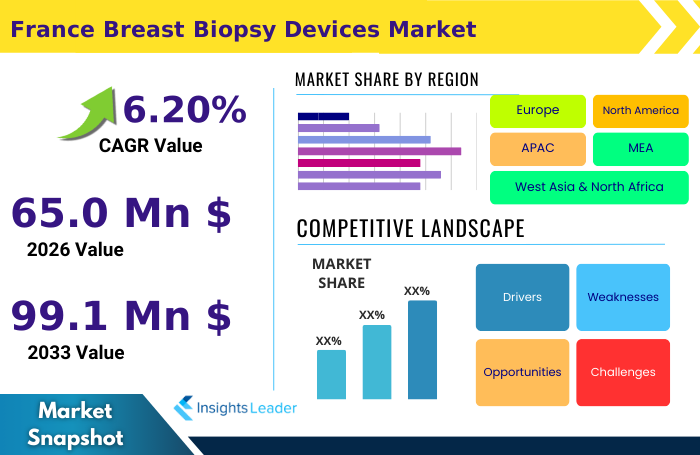
The France Breast Biopsy Devices Market Size in 2026 is estimated to be USD 65.0 Million
What is the Growth Rate (CAGR) of France Breast Biopsy Devices Market?
The France Breast Biopsy Devices Market is expected to grow at CAGR 6.2%
What is the Market Size of the France Breast Biopsy Devices in 2033?
The France Breast Biopsy Devices Market Size in 2033 is estimated to be USD 99.1 Million
What are DRO and Impact Forces of France Breast Biopsy Devices Market?
DRO stands for Drivers, Restraints, and Opportunities, which collectively represent the internal dynamics and potential paths for market growth or contraction. Drivers include technological advancements and increased cancer screening rates; Restraints involve high device costs and stringent reimbursement policies. Impact Forces, conversely, are external macro-environmental elements, such as major shifts in public health policy, pandemic effects, or significant economic recessions that enforce rapid, unforeseen changes on the market trajectory and investment stability.
What is Impact of U.S. Tariffs on France Breast Biopsy Devices Market?
While France is the target market, US tariffs primarily affect the global supply chain for key components, raw materials, and finished medical devices manufactured overseas. Tariffs can increase the cost of imported high-precision needles, vacuum-assisted biopsy (VAB) systems, and imaging equipment used in conjunction with biopsy procedures, leading to higher procurement costs for French hospitals and diagnostic centers. This economic pressure can slightly constrain market growth or necessitate adjustments in pricing strategies by multinational medical device manufacturers operating in the French ecosystem.
How is AI currently impacting France Breast Biopsy Devices Market?
AI is fundamentally transforming global industries by optimizing operations, enhancing predictive analytics, and enabling personalized services, especially within healthcare and manufacturing. In the medical field, AI algorithms are crucial for analyzing complex imaging data (mammograms, ultrasounds) with increased speed and accuracy, aiding clinicians in suspicious lesion detection and classification prior to the biopsy procedure itself. This integration streamlines diagnostic workflows, potentially reducing false-negative rates and ultimately improving patient outcomes globally.