Germany Healthcare Interoperability Solutions Market Size and Insights – 2026 to 2033
Report ID : IL_6446 | Report Language's : En/Jp/Fr/De | Publisher : IL |
Format : 


What is the Market Size of the Germany Healthcare Interoperability Solutions in 2026?
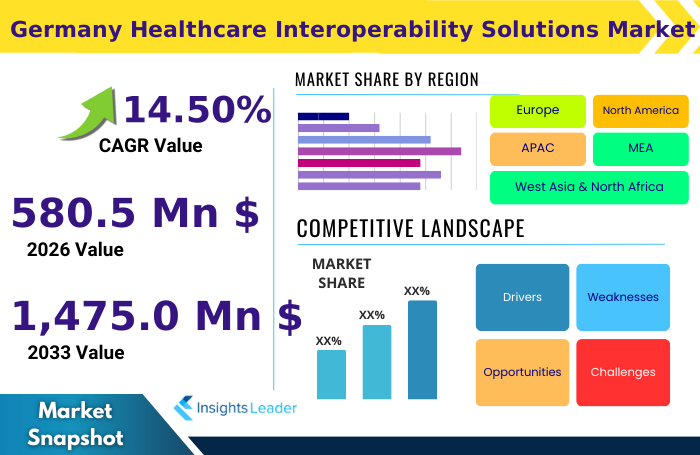
The Germany Healthcare Interoperability Solutions Market Size in 2026 is estimated to be $580.5 Million USD
What is the Growth Rate (CAGR) of Germany Healthcare Interoperability Solutions Market?
The Germany Healthcare Interoperability Solutions Market is expected to grow at 14.5% CAGR
What is the Market Size of the Germany Healthcare Interoperability Solutions in 2033?
The Germany Healthcare Interoperability Solutions Market Size in 2033 is estimated to be $1,475.0 Million USD
What are DRO and Impact Forces of Germany Healthcare Interoperability Solutions Market?
DRO refers to Drivers, Restraints, and Opportunities. Key drivers include government mandates like the eHealth Act and increasing demand for seamless data exchange. Restraints involve complex legacy IT infrastructure and high compliance costs. Opportunities lie in artificial intelligence integration and cross-border data sharing initiatives, bolstering market expansion potential.
What is Impact of U.S. Tariffs on Germany Healthcare Interoperability Solutions Market?
While direct US tariffs on hardware components might affect the cost of IT infrastructure utilized by German healthcare providers, the primary indirect impact is felt through software licensing and technology partnerships. German firms relying on proprietary US interoperability standards or software tools may face increased procurement costs, potentially slowing the pace of local implementation projects in the short term, though local solution providers are mitigating this effect.
How is AI currently impacting Germany Healthcare Interoperability Solutions Market?
AI is revolutionizing industries globally by enabling sophisticated predictive analytics, automating repetitive tasks, and enhancing decision-making capabilities across various sectors. In healthcare, specifically, AI facilitates pattern recognition in clinical data, improves diagnostic accuracy, optimizes supply chain management, and powers advanced natural language processing tools for clinical documentation, thereby significantly accelerating efficiency and innovation worldwide.