Malaysia Cyber Security Market Size and Insights – 2026 to 2033
Report ID : IL_3102 | Report Language's : En/Jp/Fr/De | Publisher : IL |
Format : 


What is the Market Size of the Malaysia Cyber Security in 2026?
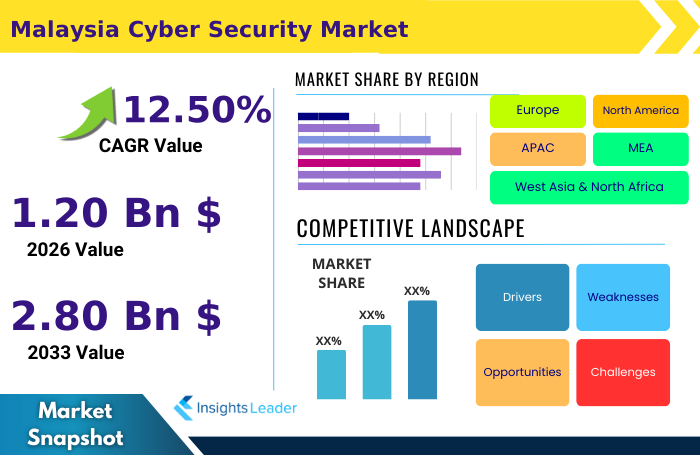
The Malaysia Cyber Security Market Size in 2026 is estimated to be $1.20 Billion USD
What is the Growth Rate (CAGR) of Malaysia Cyber Security Market?
The Malaysia Cyber Security Market is expected to grow at 12.5% CAGR
What is the Market Size of the Malaysia Cyber Security in 2033?
The Malaysia Cyber Security Market Size in 2033 is estimated to be $2.80 Billion USD
What are DRO & Impact Forces?
Drivers, Restraints, and Opportunities (DRO) define the dynamic landscape of the Malaysia Cyber Security Market. Key drivers include the government’s push for digital transformation (MyDigital initiative) and the mandatory adherence to local data sovereignty laws. The escalating frequency and sophistication of state-sponsored cyber-attacks also necessitate increased security spending across critical infrastructure sectors. However, growth is moderated by restraints such as the significant shortage of skilled local cybersecurity professionals, leading to reliance on external consultancy. Opportunities are abundant in the adoption of cloud security solutions and the rise of Managed Security Services Providers (MSSPs) tailored for the high volume of Small and Medium Enterprises (SMEs).
What is Impact of US tariffs?
The implementation of US tariffs, particularly those affecting the global technology supply chain, has an indirect but significant impact on the Malaysian cybersecurity sector. These tariffs generally increase the acquisition costs of high-end networking hardware and security appliance components manufactured in or routed through affected regions. This cost inflation can pressure IT budgets, especially for organizations reliant on perimeter defense hardware. Conversely, these geopolitical trade measures accelerate the trend of supply chain diversification. Malaysia is increasingly viewed as a stable location for manufacturing, software development, and service outsourcing, potentially benefiting its local tech ecosystem. This shift could drive investment into domestic security development and cloud-native solutions, reducing reliance on tariff-impacted imported hardware.
How is AI currently impacting industries globally?
Artificial Intelligence (AI) and Machine Learning (ML) are fundamentally reshaping global industrial operations by enabling unprecedented levels of automation, predictive analytics, and process optimization. In sectors like finance and healthcare, AI is crucial for automated fraud detection and diagnostic support, dramatically improving efficiency and reducing human error. This technological integration is simultaneously driving productivity gains and creating complex new ethical and governance challenges related to data privacy and bias.
In the context of cybersecurity, AI is a dual-edged sword. It powers next-generation defense mechanisms, offering predictive capabilities to neutralize threats before they execute, particularly in endpoint detection and response (EDR). However, malicious actors are also leveraging generative AI to create highly convincing phishing campaigns, sophisticated malware, and automated attack frameworks, escalating the complexity of the global threat landscape.
AI drives efficiency in manufacturing through predictive maintenance and optimizing logistics across global supply chains.
It is revolutionizing cybersecurity by enabling autonomous threat hunting and real-time anomaly detection, dramatically shortening incident response times.
The proliferation of Large Language Models (LLMs) poses new risks, including the creation of deepfake content and highly personalized, socially engineered attacks.