Malaysia Vertical Farming Market Size and Insights – 2026 to 2033
Report ID : IL_6272 | Report Language's : En/Jp/Fr/De | Publisher : IL |
Format : 



What is the Market Size of the Malaysia Vertical Farming in 2026?
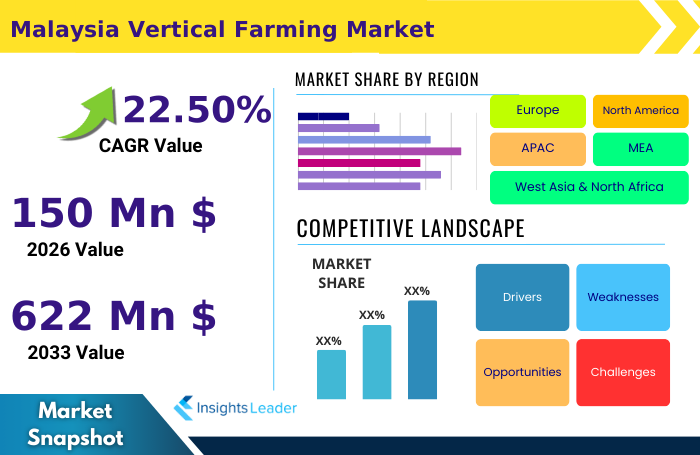
The Malaysia Vertical Farming Market Size in 2026 is estimated to be USD 150 Million
What is the Growth Rate (CAGR) of Malaysia Vertical Farming Market?
The Malaysia Vertical Farming Market is expected to grow at 22.5% CAGR
What is the Market Size of the Malaysia Vertical Farming in 2033?
The Malaysia Vertical Farming Market Size in 2033 is estimated to be USD 622 Million
What are DRO and Impact Forces of Malaysia Vertical Farming Market?
Drivers include rising concerns over food security, rapid urbanization leading to land scarcity, and increasing consumer demand for locally sourced, high-quality produce. Restraints focus primarily on the high initial capital expenditure (CAPEX) required for sophisticated controlled environment agriculture (CEA) systems and the persistent high operational energy costs. Opportunities are derived from robust government support, subsidies for agricultural technology adoption, and advancements in energy-efficient LED lighting and automated environmental control systems.
What is Impact of U.S. Tariffs on Malaysia Vertical Farming Market?
The direct impact of US tariffs on the Malaysian vertical farming sector is relatively low concerning final produce, as vertical farms primarily cater to domestic supply chains. However, tariffs indirectly affect the cost structure by impacting the global sourcing of specialized components, such as sensors, advanced climate control units, and specific automated hardware, which are often manufactured or sourced through multinational supply chains affected by geopolitical trade tensions. This potentially increases the overall initial investment cost for farm setup.
How is AI currently impacting Malaysia Vertical Farming Market?
Artificial Intelligence (AI) is transforming industries globally by enabling hyper-optimization, predictive modeling, and automation. In manufacturing and logistics, AI optimizes supply chains and demand forecasting. In agriculture, specifically vertical farming, AI systems monitor environmental parameters (nutrient levels, temperature, humidity) in real-time to adjust inputs precisely, reducing waste and maximizing yield output through predictive analytics and automated climate control.