North America Breast Biopsy Devices Market Size and Insights – 2026 to 2033
Report ID : IL_6094 | Report Language's : En/Jp/Fr/De | Publisher : IL |
Format : 


What is the Market Size of the North America Breast Biopsy Devices in 2026?
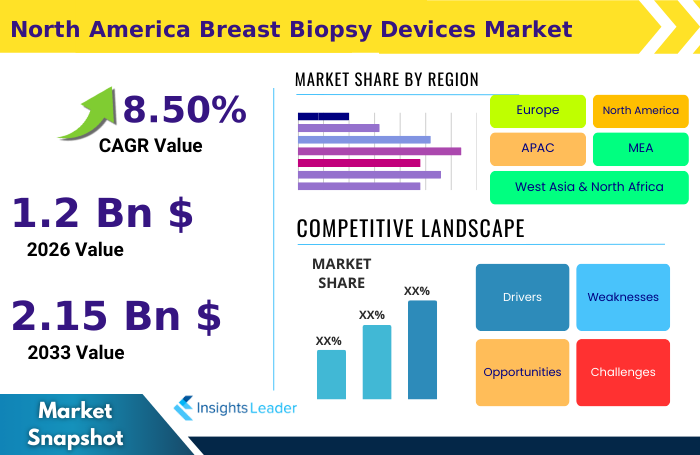
The North America Breast Biopsy Devices Market Size in 2026 is estimated to be USD 1.2 Billion
What is the Growth Rate (CAGR) of North America Breast Biopsy Devices Market?
The North America Breast Biopsy Devices Market is expected to grow at CAGR 8.5%
What is the Market Size of the North America Breast Biopsy Devices in 2033?
The North America Breast Biopsy Devices Market Size in 2033 is estimated to be USD 2.15 Billion
What are DRO and Impact Forces of North America Breast Biopsy Devices Market?
Driving, Restraining, and Opportunity (DRO) forces are the analytical framework used to assess market dynamics. Driving forces include factors like increasing breast cancer incidence and adoption of minimally invasive procedures, pushing market growth forward. Restraining forces involve high device costs and stringent regulatory frameworks. Opportunity forces identify potential areas for expansion, such as technological integration (AI-guided biopsies) and underserved patient demographics.
What is Impact of U.S. Tariffs on North America Breast Biopsy Devices Market?
The imposition of US tariffs can increase the operational costs for companies sourcing components from affected regions, particularly Asia. This impacts the profitability of breast biopsy device manufacturers and may lead to upward pressure on final product prices, potentially slowing down technology adoption in price-sensitive settings. Furthermore, it often necessitates supply chain diversification and reshoring efforts to mitigate future risk exposure.
How is AI currently impacting North America Breast Biopsy Devices Market?
AI is fundamentally reshaping global industries by enabling advanced data processing, predictive modeling, and automation of routine tasks. In the medical sector, AI algorithms are significantly enhancing diagnostic accuracy in imaging (e.g., mammography and ultrasound guidance), optimizing surgical planning, and improving patient risk stratification, thereby driving efficiency and personalization in care delivery worldwide.