North America Cyber Security Market Size and Insights – 2026 to 2033
Report ID : IL_3062 | Report Language's : En/Jp/Fr/De | Publisher : IL |
Format : 


What is the Market Size of the North America Cyber Security in 2026?
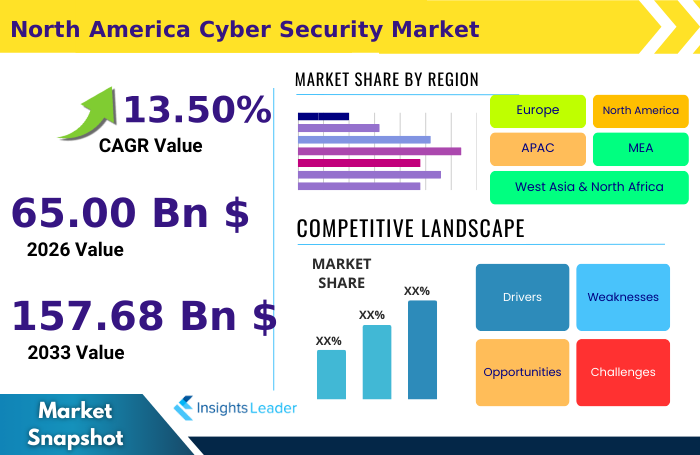
The North America Cyber Security Market Size in 2026 is estimated to be USD 65.00 Billion
What is the Growth Rate (CAGR) of North America Cyber Security Market?
The North America Cyber Security Market is expected to grow at 13.5% CAGR
What is the Market Size of the North America Cyber Security in 2033?
The North America Cyber Security Market Size in 2033 is estimated to be USD 157.68 Billion
What are DRO & Impact Forces?
DRO stands for Drivers, Restraints, and Opportunities, the essential forces shaping market dynamics. Drivers propel growth through increased adoption and demand, often related to regulatory compliance or technological advancements like cloud migration. Restraints are limitations such as high initial deployment costs or complexity in integrating disparate security solutions, while Opportunities represent new avenues for growth, often involving emerging technologies like AI-driven security automation or specialized IoT protection. Analyzing DRO is crucial for strategic planning and forecasting market resilience against economic and technological shifts.
What is Impact of US tariffs?
The impact of US tariffs, particularly those related to technology hardware and imported components, can increase the cost of security infrastructure deployment for businesses across North America. Tariffs may disrupt established supply chains, leading to delays in receiving necessary equipment like network appliances and servers crucial for robust cybersecurity systems. This cost increase potentially slows down the rate of security modernization, particularly for Small and Medium-sized Enterprises (SMEs), which operate on tighter capital expenditure budgets, thus indirectly affecting the overall market adoption of advanced physical security tools.
How is AI currently impacting industries globally?
Artificial Intelligence (AI) is transforming global industries by fundamentally enhancing automation, accelerating data analysis, and enabling predictive decision-making across diverse functions. In manufacturing, AI optimizes supply chains and predictive maintenance, while in healthcare, it accelerates diagnostics and drug discovery, leading to substantial efficiency gains and cost reductions. This technology is driving a massive shift toward intelligent operations, requiring significant investment in computational infrastructure and specialized talent to capitalize on its expansive capabilities.