Singapore Cyber Security Market Size and Insights – 2026 to 2033
Report ID : IL_3022 | Report Language's : En/Jp/Fr/De | Publisher : IL |
Format : 


What is the Market Size of the Singapore Cyber Security in 2026?
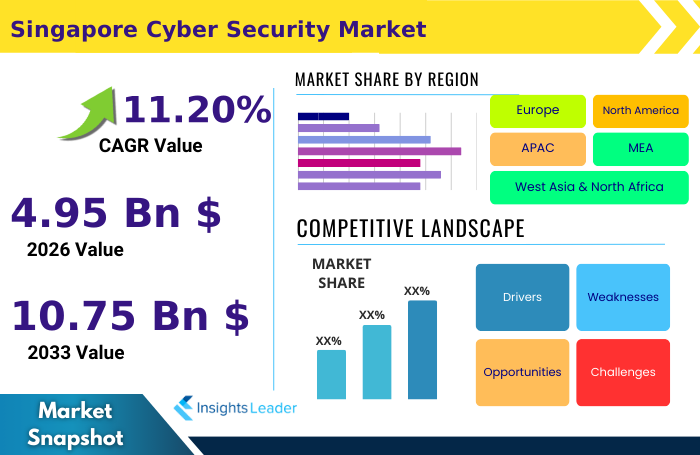
The Singapore Cyber Security Market Size in 2026 is estimated to be USD 4.95 Billion
What is the Growth Rate (CAGR) of Singapore Cyber Security Market?
The Singapore Cyber Security Market is expected to grow at 11.2% CAGR
What is the Market Size of the Singapore Cyber Security in 2033?
The Singapore Cyber Security Market Size in 2033 is estimated to be USD 10.75 Billion
What are DRO & Impact Forces?
Drivers (D) include rapid governmental digital transformation initiatives (Smart Nation) and the increasing sophistication of regional cyber threats targeting critical infrastructure. Restraints (R) primarily involve the persistent shortage of highly specialized cybersecurity talent required to manage advanced defense systems, increasing reliance on external consulting. Opportunities (O) emerge from mandatory regulatory compliance frameworks (e.g., MAS TRM) driving demand for specialized compliance software and managed security services.
What is Impact of US tariffs?
The direct impact of US tariffs on Singapore’s cybersecurity software market is minimal; however, tariffs on specialized hardware components, such as next-generation firewall appliances and secure data center equipment, can increase operational costs for vendors. This results in potential supply chain restructuring as companies seek alternative sourcing in Southeast Asia to maintain competitive pricing. Additionally, global trade tensions may subtly influence cross-border data transfer policies and international vendor procurement decisions in Singapore.
How is AI currently impacting industries globally?
AI is fundamentally transforming industry security postures by automating the detection and response to anomalies far faster than human teams, significantly reducing mean time to detection (MTTD). Conversely, it is also leveraged by threat actors to create highly customized, scalable phishing campaigns and polymorphic malware that evade traditional signature-based security tools. This duality necessitates a shift toward adaptive security architectures, such as XDR and SOAR platforms, that utilize machine learning for proactive threat hunting and predictive risk modeling across organizational networks.