Asia-Pacific Asynchronous Motor Market Size and Insights – 2026 to 2033
Report ID : IL_6788 | Report Language's : En/Jp/Fr/De | Publisher : IL |
Format : 


What is the Market Size of the Asia-Pacific Asynchronous Motor in 2026?
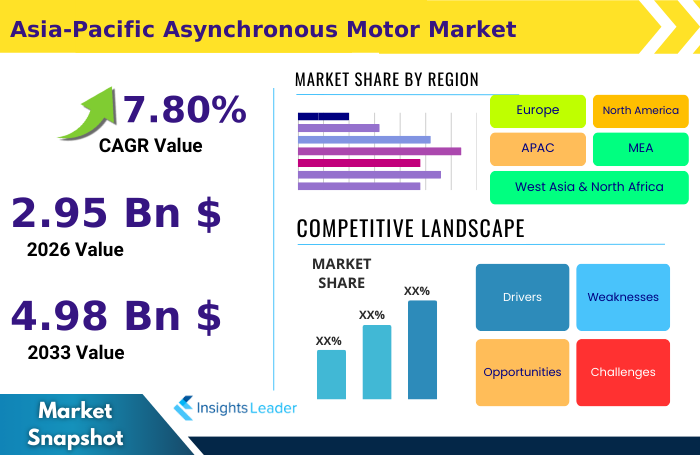
The Asia-Pacific Asynchronous Motor Market Size in 2026 is estimated to be $2.95 Billion USD
What is the Growth Rate (CAGR) of Asia-Pacific Asynchronous Motor Market?
The Asia-Pacific Asynchronous Motor Market is expected to grow at CAGR 7.8%
What is the Market Size of the Asia-Pacific Asynchronous Motor in 2033?
The Asia-Pacific Asynchronous Motor Market Size in 2033 is estimated to be $4.98 Billion USD
What are DRO and Impact Forces of Asia-Pacific Asynchronous Motor Market?
Drivers, Restraints, and Opportunities (DRO) constitute the core analytical framework for evaluating market dynamics, detailing internal factors that promote or hinder growth, alongside potential avenues for expansion. Impact Forces specifically refer to significant, external macro-environmental events, such as geopolitical shifts, major regulatory changes, or economic shocks, that possess the capability to drastically alter the trajectory and assumptions underpinning market forecasts within the asynchronous motor sector.
What is Impact of U.S. Tariffs on Asia-Pacific Asynchronous Motor Market?
The implementation of US tariffs, particularly against major manufacturing hubs in the Asia-Pacific region, has notably increased the acquisition costs for asynchronous motors and their essential components, leading to global supply chain volatility. This macroeconomic pressure incentivizes APAC-based manufacturers to strategically diversify their export markets and proactively reconfigure their production logistics, often resulting in increased investment and manufacturing shifts towards alternative regional centers like Vietnam, India, and Thailand to mitigate tariff exposure.
How is AI currently impacting Asia-Pacific Asynchronous Motor Market?
AI is fundamentally reshaping industrial operations globally by enabling sophisticated predictive maintenance protocols, significantly reducing unplanned downtime, and optimizing the operational lifecycles of asynchronous motors. Through integration into Industrial Internet of Things (IIoT) platforms, AI algorithms analyze vast datasets derived from motor performance, facilitating unparalleled energy efficiency gains and automated, precise fault detection across energy-intensive sectors such as heavy manufacturing, automotive production, and chemical processing.