Canada Laptop Market Size and Insights – 2026 to 2033
Report ID : IL_3190 | Report Language's : En/Jp/Fr/De | Publisher : IL |
Format : 


What is the Market Size of the Canada Laptop in 2026?
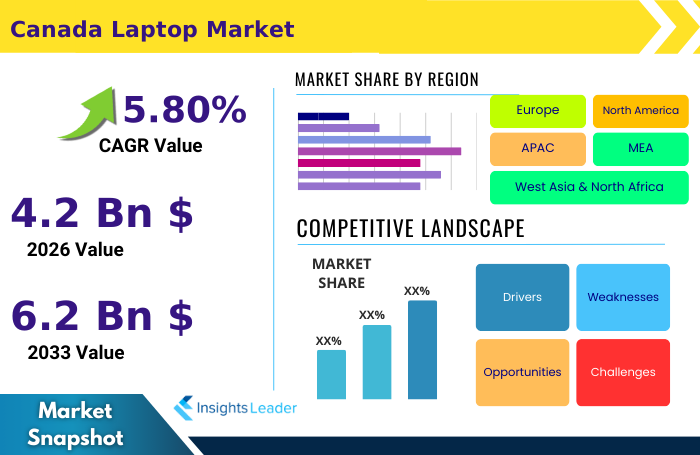
The Canada Laptop Market Size in 2026 is estimated to be USD 4.2 Billion
What is the Growth Rate (CAGR) of Canada Laptop Market?
The Canada Laptop Market is expected to grow at 5.8% CAGR
What is the Market Size of the Canada Laptop in 2033?
The Canada Laptop Market Size in 2033 is estimated to be USD 6.2 Billion
What are DRO & Impact Forces?
Driving forces include the continued adoption of hybrid work models, increasing demand for specialized gaming laptops, and government initiatives promoting digital education infrastructure.Restraining factors involve market saturation in specific consumer segments and the macroeconomic pressure of high inflation impacting discretionary consumer spending on premium devices.Opportunities are significant in the integration of AI-enabled PCs (Neural Processing Units or NPUs) and the rising corporate focus on device-as-a-service (DaaS) subscriptions.
What is Impact of US tariffs?
While Canada does not impose the same tariffs, US tariffs on goods manufactured in Asia, particularly China, indirectly influence the Canadian market through complex supply chain dynamics.Increased manufacturing and component costs absorbed by international OEMs are often reflected in higher wholesale pricing for the Canadian distribution channel.This indirect cost pressure can lead to elevated retail prices for Canadian consumers, potentially slowing down replacement cycles or shifting preference toward more budget-friendly alternatives.
How is AI currently impacting industries globally?
AI is fundamentally transforming global industries by optimizing operational efficiencies, driving predictive maintenance in manufacturing, and enabling advanced personalized customer experiences across retail and finance sectors. The introduction of AI PCs, featuring dedicated NPUs, is shifting hardware demand toward devices capable of handling complex on-device machine learning tasks. This hardware evolution is critical for data security and efficient processing in industries requiring high computational power and low latency, such as engineering and advanced scientific research.