Canada Microbial fuel cells (MFC) Market Size and Insights – 2026 to 2033
Report ID : IL_16812 | Report Language's : En/Jp/Fr/De | Publisher : IL |
Format : 


What is the Market Size of the Canada Microbial fuel cells (MFC) in 2026?
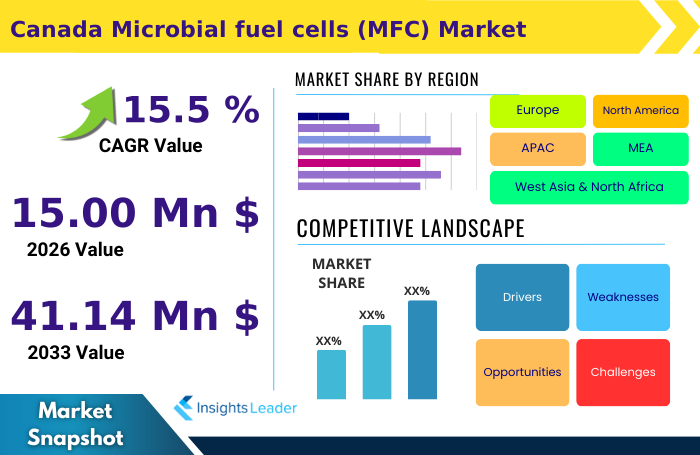
The Canada Microbial fuel cells (MFC) Market Size in 2026 is estimated to be USD 15.00 Million
What is the Growth Rate (CAGR) of Canada Microbial fuel cells (MFC) Market?
The Canada Microbial fuel cells (MFC) Market is expected to grow at 15.5% CAGR
What is the Market Size of the Canada Microbial fuel cells (MFC) in 2033?
The Canada Microbial fuel cells (MFC) Market Size in 2033 is estimated to be USD 41.14 Million
Report Snapshot
| Report Attributes | Report Details |
|---|---|
| Forecast Year | 2033 |
| CAGR | 15.5% |
| History Year | 2016-2024 |
| Market Size in 2026 | 15.00 Million USD$ |
| Market Size in 2033 | 41.14 Million USD$ |
What are DRO & Impact Forces of Canada Microbial fuel cells (MFC) Market?
Drivers include the increasing governmental emphasis on decentralized and sustainable wastewater treatment solutions, coupled with the rising demand for low-power energy generation systems in remote Canadian locations and sensor deployments. Restraints are primarily focused on the high initial capital investment required for MFC systems, performance instability, and the relatively low power density output compared to traditional energy sources, hindering large-scale commercialization. Opportunities arise from technological advancements in electrode materials and system architecture, enabling broader application in bioremediation and biosensor development.
What is Impact of US Tariffs on Canada Microbial fuel cells (MFC) Market?
The direct impact of U.S. tariffs on fully assembled Canadian MFC systems is generally low due to the niche nature of the technology; however, tariffs on specialized components, particularly advanced membrane materials, catalysts, and electronic control units sourced via complex cross-border supply chains or third-party suppliers, can lead to moderate cost inflation. This tariff environment encourages Canadian manufacturers to localize the sourcing of materials and components, promoting domestic innovation but potentially slowing immediate integration of the latest U.S.-developed technologies.
How is AI currently impacting Canada Microbial fuel cells (MFC) Market?
Artificial Intelligence (AI) is transforming MFC operations by enabling real-time process optimization and predictive maintenance. AI algorithms analyze fluctuating parameters like substrate concentration, pH levels, and external temperature variations to dynamically adjust operating conditions, ensuring maximized electron transfer rates and stable power output, which is critical for long-term viability in field applications. Furthermore, AI-driven predictive modeling helps researchers and industrial users forecast system degradation and identify potential failures before they occur, significantly reducing operational downtime and lowering the total cost of ownership (TCO) for deployed MFC units in challenging Canadian environments.
Canada Microbial fuel cells (MFC) Market Research Report – Table of Contents
1. Executive Summary
2. Introduction & Research Objectives
3. Scope of the Study
4. Research Methodology of Canada Microbial fuel cells (MFC) Market
5. Canada Microbial fuel cells (MFC) Market Overview & Industry Background
6. Canada Microbial fuel cells (MFC) Market Size & Forecast Analysis
7. Canada Microbial fuel cells (MFC) Market Segmentation Analysis
8. Competitive Landscape
9. Consumer Behavior & Demand Analysis
10. Pricing & Cost Structure Analysis
11. Canada Microbial fuel cells (MFC) Market Drivers, Challenges & Risks
12. Regulatory & Policy Framework
13. Technology & Innovation Impact
14. Strategic Insights & Recommendations
15. Conclusion & Future Outlook
For more queries, kindly contact [email protected]