France Cyber Security Market Size and Insights – 2026 to 2033
Report ID : IL_3152 | Report Language's : En/Jp/Fr/De | Publisher : IL |
Format : 


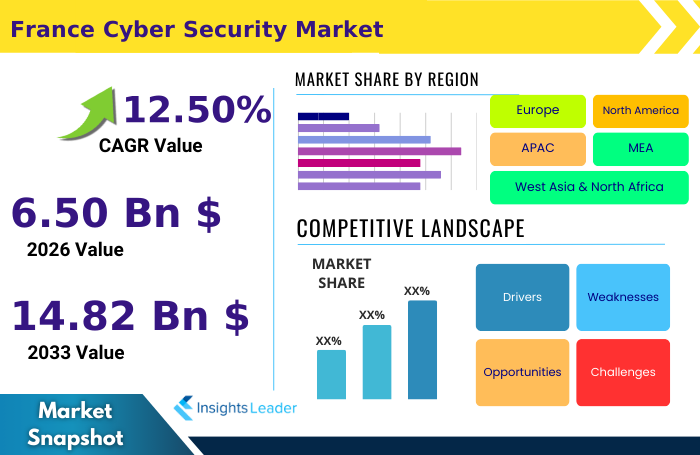
What is the Market Size of the France Cyber Security in 2026?
The France Cyber Security Market Size in 2026 is estimated to be USD 6.50 Billion
What is the Growth Rate (CAGR) of France Cyber Security Market?
The France Cyber Security Market is expected to grow at CAGR 12.5%
What is the Market Size of the France Cyber Security in 2033?
The France Cyber Security Market Size in 2033 is estimated to be USD 14.82 Billion
What are DRO & Impact Forces?
Drivers include stringent European Union regulations like GDPR and NIS2, mandating higher compliance standards and increased security investments across critical infrastructure sectors. Restraints encompass the critical shortage of skilled cybersecurity professionals and the high cost of adopting advanced security solutions, particularly for SMEs. Opportunities arise from the accelerated adoption of cloud services and the necessity for robust Zero Trust architectures to secure hybrid working environments and interconnected supply chains.
What is Impact of US tariffs?
The direct impact of US tariffs on the predominantly software- and service-based French cybersecurity market is relatively moderate compared to hardware-centric industries. However, indirect effects manifest through supply chain disruptions for networking equipment and servers imported via global manufacturers, potentially delaying infrastructure upgrades. Furthermore, broad economic uncertainty caused by tariff disputes can restrict corporate IT budgets, leading to slower investment cycles in high-end security products and solutions within the French ecosystem.
How is AI currently impacting industries globally?
AI is fundamentally reshaping industrial operations by automating complex processes, optimizing supply chain logistics, and enabling predictive maintenance across manufacturing and utilities. In cybersecurity, AI significantly enhances threat detection capabilities through behavioral analytics and anomaly identification, reducing response times for sophisticated attacks. Conversely, AI is also being leveraged by malicious actors to create highly effective deepfake phishing campaigns and polymorphic malware, necessitating continuous defensive innovation.