France Graphic Processor Market Size and Insights – 2026 to 2033
Report ID : IL_6460 | Report Language's : En/Jp/Fr/De | Publisher : IL |
Format : 


What is the Market Size of the France Graphic Processor in 2026?
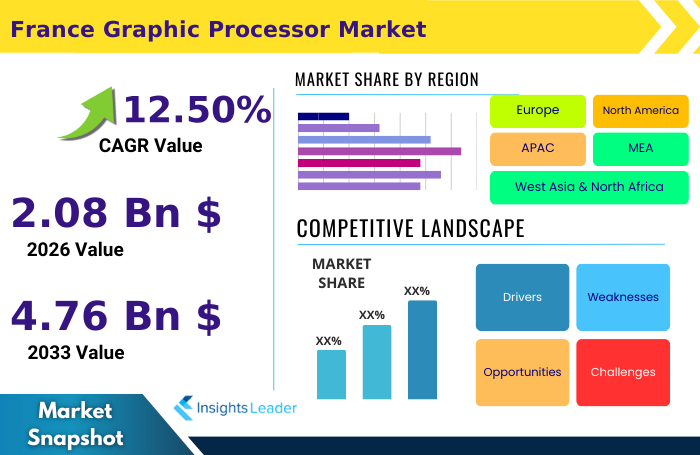
The France Graphic Processor Market Size in 2026 is estimated to be USD 2.08 Billion
What is the Growth Rate (CAGR) of France Graphic Processor Market?
The France Graphic Processor Market is expected to grow at CAGR 12.5%
What is the Market Size of the France Graphic Processor in 2033?
The France Graphic Processor Market Size in 2033 is estimated to be USD 4.76 Billion
What are DRO and Impact Forces of France Graphic Processor Market?
Drivers, Restraints, and Opportunities (DRO) are foundational market dynamics. Drivers are factors stimulating market growth (e.g., gaming and AI adoption); Restraints impede growth (e.g., component shortages); and Opportunities represent potential expansion areas (e.g., edge computing). Impact Forces are external, macro-environmental pressures, such as shifts in consumer technology policy or regulatory actions, that critically influence strategic decision-making and market direction.
What is Impact of U.S. Tariffs on France Graphic Processor Market?
US tariffs on semiconductor components and specialized electronics imported from certain regions introduce significant cost volatility and increase the overall Cost of Goods Sold (COGS) for graphic processor manufacturers supplying the French market. This frequently translates to elevated retail prices for high-performance GPUs, potentially tempering consumer demand and prompting companies to restructure their supply chains toward tariff-neutral manufacturing hubs to maintain competitive pricing and stability.
How is AI currently impacting France Graphic Processor Market?
AI is universally enabling rapid digital transformation through sophisticated data processing, automation, and predictive modeling capabilities across diverse sectors. Globally, industries rely on high-throughput graphic processors to power complex AI workloads, including the training of expansive machine learning models, enhancing autonomous system performance, accelerating pharmaceutical research, and establishing robust, data-intensive cloud infrastructure services.