Germany Digital Twin Market Size and Insights – 2026 to 2033
Report ID : IL_11823 | Report Language's : En/Jp/Fr/De | Publisher : IL |
Format : 


What is the Market Size of the Germany Digital Twin in 2026?
The Germany Digital Twin Market Size in 2026 is estimated to be USD 3.50 Billion
What is the Growth Rate (CAGR) of Germany Digital Twin Market?
The Germany Digital Twin Market is expected to grow at 22.5% CAGR
What is the Market Size of the Germany Digital Twin in 2033?
The Germany Digital Twin Market Size in 2033 is estimated to be USD 14.45 Billion
Report Snapshot
| Report Attributes | Report Details |
|---|---|
| Forecast Year | 2033 |
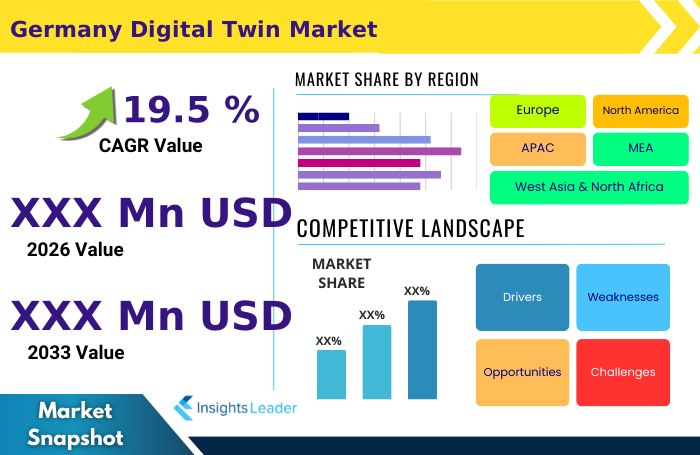
| CAGR | 22.5% |
| History Year | 2016-2024 |
| Market Size in 2026 | USD 3.50 Billion |
| Market Size in 2033 | USD 14.45 Billion |
What are DRO & Impact Forces of Germany Digital Twin Market?
Drivers include strong government backing for Industry 4.0 initiatives and substantial uptake in the high-value German automotive and industrial machinery sectors seeking optimization. Restraints involve significant initial investment costs and complexity in ensuring data privacy compliance (GDPR) for operational data models. Opportunities are centered around extending applications into smart infrastructure management and expanding predictive maintenance capabilities across the mid-sized enterprise segment.
What is Impact of US Tariffs on Germany Digital Twin Market?
While Digital Twin solutions are often domestically driven by efficiency requirements, U.S. tariffs primarily impact German export-oriented manufacturing output. Reduced trade volumes or uncertainty resulting from tariffs can slow capital expenditure decisions in core industries, leading to deferred investments in advanced technologies like Digital Twins. However, the strong internal focus on efficiency driven by high domestic labor costs provides a structural buffer against external trade volatility.
How is AI currently impacting Germany Digital Twin Market?
Artificial Intelligence is foundational to maximizing the efficacy of Digital Twins, primarily by automating the analysis of real-time sensor data and enhancing predictive modeling accuracy. AI algorithms enable the twin to identify anomalies, forecast equipment failure with greater precision, and optimize complex operational parameters beyond human capacity. This integration transforms the twin from a mere simulation tool into an autonomous, self-optimizing system capable of driving proactive decision-making.
Germany Digital Twin Market Research Report – Table of Contents
1. Executive Summary
2. Introduction & Research Objectives
3. Scope of the Study
4. Research Methodology of Germany Digital Twin Market
5. Germany Digital Twin Market Overview & Industry Background
6. Germany Digital Twin Market Size & Forecast Analysis
7. Germany Digital Twin Market Segmentation Analysis
8. Competitive Landscape
9. Consumer Behavior & Demand Analysis
10. Pricing & Cost Structure Analysis
11. Germany Digital Twin Market Drivers, Challenges & Risks
12. Regulatory & Policy Framework
13. Technology & Innovation Impact
14. Strategic Insights & Recommendations
15. Conclusion & Future Outlook
For more queries, kindly contact [email protected]