Indonesia Unified Communications Market Size and Insights – 2026 to 2033
Report ID : IL_17785 | Report Language's : En/Jp/Fr/De | Publisher : IL |
Format : 


What is the Market Size of the Indonesia Unified Communications in 2026?
The Indonesia Unified Communications Market Size in 2026 is estimated to be $450 Million USD
What is the Growth Rate (CAGR) of Indonesia Unified Communications Market?
The Indonesia Unified Communications Market is expected to grow at CAGR 14.5%
What is the Market Size of the Indonesia Unified Communications in 2033?
The Indonesia Unified Communications Market Size in 2033 is estimated to be $1,150 Million USD
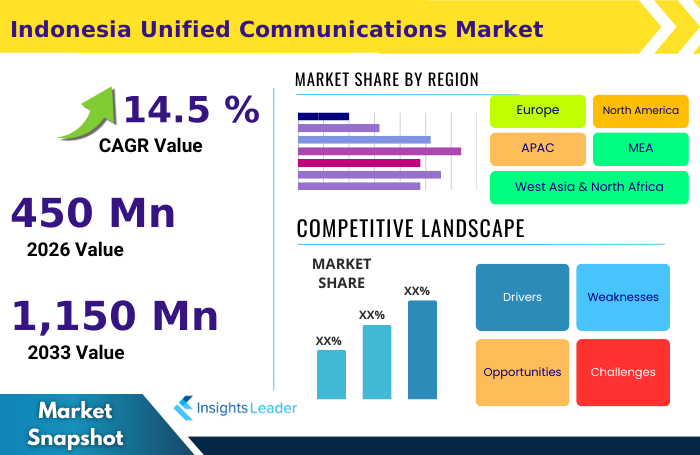
Report Snapshot
| Report Attributes | Report Details |
|---|---|
| Forecast Year | 2033 |
| CAGR | 14.5% |
| History Year | 2016-2024 |
| Market Size in 2026 | 450 Million USD |
| Market Size in 2033 | 1,150 Million USD |
What are DRO and Impact Forces of Indonesia Unified Communications Market?
Drivers include rapid digital transformation across small and medium enterprises (SMEs), accelerated adoption of remote and hybrid work models, and critical government investment in national digital infrastructure projects like Palapa Ring, improving connectivity essential for UC services. Restraints involve high initial capital expenditure (CAPEX) for on-premise solutions, regulatory complexity in data localization, and challenges integrating sophisticated UC systems with diverse legacy IT infrastructures prevalent across various Indonesian regions. Opportunities are primarily driven by the expansion of 5G networks, enabling high-quality UCaaS (Unified Communications as a Service) offerings, and strategic penetration into high-growth vertical sectors such as healthcare and education.
What is Impact of U.S. Tariffs on Indonesia Unified Communications Market?
The primary impact of U.S. tariffs is an increase in the cost of networking hardware and specialized telecommunications components imported from key manufacturing hubs. This rise in input costs affects global UC vendors operating in Indonesia, particularly those reliant on specialized hardware for on-premise solutions or complex network infrastructure deployments. Consequently, tariffs slightly accelerate the market pivot toward cloud-based UCaaS models, which minimize dependency on high-cost imported hardware, favoring software-centric deployment strategies.
How is AI currently impacting Indonesia Unified Communications Market?
AI is fundamentally reshaping the efficiency and user experience within the Indonesian UC market by automating routine communication tasks and enhancing analytical capabilities. Key applications include advanced intelligent call routing systems that optimize workload distribution, natural language processing (NLP) for real-time transcription and automated meeting summaries, and sophisticated AI chatbots providing immediate, high-quality tier-one customer service. These integrations improve enterprise productivity and drive the adoption of platforms capable of delivering personalized, data-driven communication solutions.
Indonesia Unified Communications Market Research Report – Table of Contents
1. Executive Summary
2. Introduction & Research Objectives
3. Scope of the Study
4. Research Methodology of Indonesia Unified Communications Market
5. Indonesia Unified Communications Market Overview & Industry Background
6. Indonesia Unified Communications Market Size & Forecast Analysis
7. Indonesia Unified Communications Market Segmentation Analysis
8. Competitive Landscape
9. Consumer Behavior & Demand Analysis
10. Pricing & Cost Structure Analysis
11. Indonesia Unified Communications Market Drivers, Challenges & Risks
12. Regulatory & Policy Framework
13. Technology & Innovation Impact
14. Strategic Insights & Recommendations
15. Conclusion & Future Outlook
For more queries, kindly contact [email protected]