Indonesia Vertical Farming Market Size and Insights – 2026 to 2033
Report ID : IL_6392 | Report Language's : En/Jp/Fr/De | Publisher : IL |
Format : 


What is the Market Size of the Indonesia Vertical Farming in 2026?
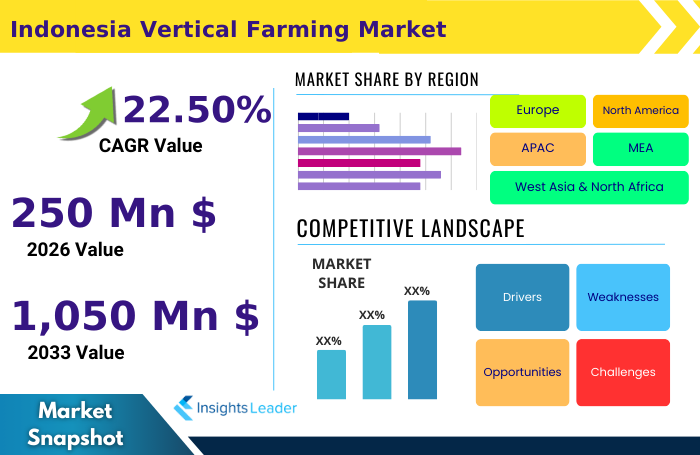
The Indonesia Vertical Farming Market Size in 2026 is estimated to be $250 Million
What is the Growth Rate (CAGR) of Indonesia Vertical Farming Market?
The Indonesia Vertical Farming Market is expected to grow at 22.5% CAGR
What is the Market Size of the Indonesia Vertical Farming in 2033?
The Indonesia Vertical Farming Market Size in 2033 is estimated to be $1,050 Million
What are DRO and Impact Forces of Indonesia Vertical Farming Market?
Drivers include accelerated urbanization and strong governmental mandates aimed at enhancing national food security and self-sufficiency. Restraints are primarily centered on the substantial upfront capital investment required and the continuous high operational costs associated with energy consumption. Opportunities emerge through technology integration, specifically the widespread adoption of advanced IoT and AI systems for precision agriculture optimization.
What is Impact of U.S. Tariffs on Indonesia Vertical Farming Market?
US tariffs primarily impact the cost structure of specialized equipment essential for vertical farming, such as sophisticated LED lighting systems, climate control units (HVAC), and precision sensing hardware. Elevated import duties on these crucial components increase the total initial capital expenditure for Indonesian vertical farming operators, potentially slowing down the rate of new project deployments and market penetration, especially among smaller enterprises reliant on foreign technology supply chains.
How is AI currently impacting Indonesia Vertical Farming Market?
AI is fundamentally reshaping industrial efficiency by enabling predictive maintenance, optimizing complex supply chain logistics, and automating critical operational processes across sectors like manufacturing, healthcare, and finance. In agriculture, AI algorithms manage resource allocation (water, nutrients) with hyper-precision, predict yield variations based on environmental inputs, and facilitate automated labor processes, leading to substantial reductions in waste and operational expenditure while boosting productivity metrics globally.