North America Asynchronous Motor Market Size and Insights – 2026 to 2033
Report ID : IL_6108 | Report Language's : En/Jp/Fr/De | Publisher : IL |
Format : 



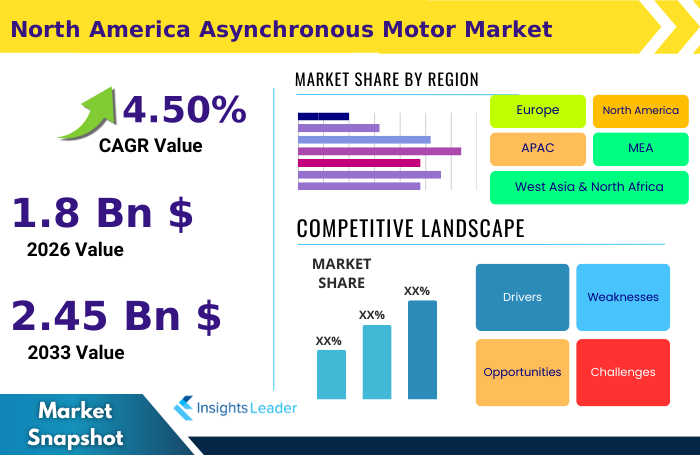
What is the Market Size of the North America Asynchronous Motor in 2026?
The North America Asynchronous Motor Market Size in 2026 is estimated to be $1.8 Billion
What is the Growth Rate (CAGR) of North America Asynchronous Motor Market?
The North America Asynchronous Motor Market is expected to grow at 4.5% CAGR
What is the Market Size of the North America Asynchronous Motor in 2033?
The North America Asynchronous Motor Market Size in 2033 is estimated to be $2.45 Billion
What are DRO and Impact Forces of North America Asynchronous Motor Market?
DRO, often referring to Demand Response Optimization in industrial contexts, involves modulating motor usage and load based on real-time energy pricing and grid requirements to maximize efficiency and minimize operational expenditure. Impact Forces are the macro-economic, regulatory, and technological pressures—such as energy efficiency mandates (e.g., NEMA Premium efficiency) and geopolitical trade tensions—that fundamentally influence market trajectory and investment decisions within the asynchronous motor sector.
What is Impact of U.S. Tariffs on North America Asynchronous Motor Market?
US tariffs primarily impact the market by increasing the cost of imported components and finished motors, particularly those sourced from East Asia. This leads to supply chain diversification away from tariff-hit regions, pressure on domestic manufacturers to absorb higher material costs, and ultimately, upward pricing revisions for end-users, potentially slowing adoption rates for replacement and new installations.
How is AI currently impacting North America Asynchronous Motor Market?
Artificial Intelligence is transforming global industries by enabling sophisticated predictive maintenance protocols, drastically reducing motor downtime through anomaly detection. Furthermore, AI optimizes operational efficiency by controlling motor speed and torque based on real-time load requirements (Smart Grids and Industrial IoT), leading to significant energy savings and enhanced production throughput across manufacturing and processing sectors.