Russia Wireless Communication Market Size and Insights – 2026 to 2033
Report ID : IL_11396 | Report Language's : En/Jp/Fr/De | Publisher : IL |
Format : 


What is the Market Size of the Russia Wireless Communication in 2026?
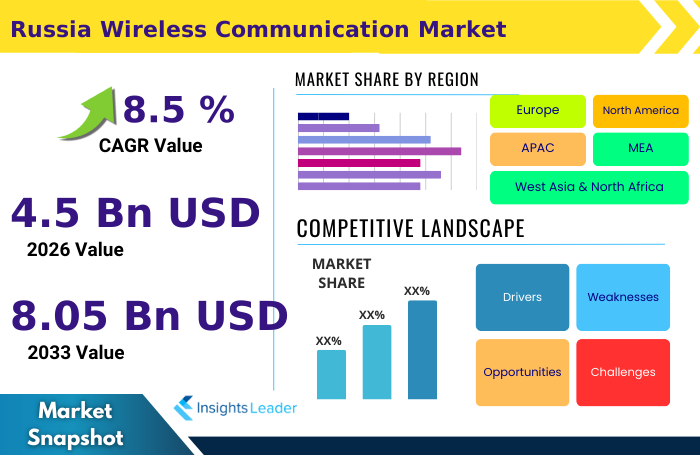
The Russia Wireless Communication Market Size in 2026 is estimated to be $4.5 Billion USD
What is the Growth Rate (CAGR) of Russia Wireless Communication Market?
The Russia Wireless Communication Market is expected to grow at 8.5% CAGR
What is the Market Size of the Russia Wireless Communication in 2033?
The Russia Wireless Communication Market Size in 2033 is estimated to be $8.05 Billion USD
Report Snapshot
| Report Attributes | Report Details |
|---|---|
| Forecast Year | 2033 |
| CAGR | 8.5% |
| History Year | 2016-2024 |
| Market Size in 2026 | $4.5 Billion USD |
| Market Size in 2033 | $8.05 Billion USD |
What are DRO & Impact Forces of Russia Wireless Communication Market?
The primary Drivers include mandated governmental investment in 5G deployment, accelerated expansion of fiber optic backbone infrastructure across remote regions, and the strategic push for domestic production of hardware to achieve technological sovereignty.Restraints are centered on geopolitical challenges, including the exit of major Western equipment vendors (Nokia, Ericsson), severely restricting access to advanced semiconductors and proprietary software required for next-generation network upgrades.Opportunities emerge from the rapid development of proprietary national satellite communication systems (e.g., the Sphere program) and the growing demand for dedicated private industrial networks (Private 5G/IoT) within crucial sectors like manufacturing and energy.
What is Impact of US Tariffs on Russia Wireless Communication Market?
U.S. tariffs and related export controls have profoundly impacted the Russian wireless communication market by causing significant supply chain fragmentation and forcing a rapid localization strategy.Major international vendors have withdrawn, leaving incumbent operators reliant on equipment sourced primarily from non-sanctioning countries, particularly China (e.g., Huawei, ZTE), and accelerating domestic technological substitution programs.This dependency shift has introduced compatibility challenges and delays in the rollout of advanced wireless standards (e.g., Standalone 5G), necessitating substantial long-term investment in domestic component manufacturing and R&D.The net impact is increased operational costs and a strategic pivot toward indigenous technological solutions to secure the nation’s critical telecom infrastructure against future external pressures.
How is AI currently impacting Russia Wireless Communication Market?
AI is currently impacting the Russian wireless market primarily through the optimization of complex network operations and enhancement of security protocols, often filling capability gaps left by the withdrawal of foreign software providers. This technology is being leveraged to improve network efficiency by implementing Self-Organizing Networks (SON) for automated traffic balancing, predictive fault detection, and energy management, which is critical given the geographical expanse of the nation. Furthermore, AI-driven solutions are crucial in bolstering cybersecurity capabilities, enabling real-time threat detection and anomaly identification within national communication networks, thereby ensuring resilience and operational continuity under increasing geopolitical stress.
Russia Wireless Communication Market Research Report – Table of Contents
1. Executive Summary
2. Introduction & Research Objectives
3. Scope of the Study
4. Research Methodology of Russia Wireless Communication Market
5. Russia Wireless Communication Market Overview & Industry Background
6. Russia Wireless Communication Market Size & Forecast Analysis
7. Russia Wireless Communication Market Segmentation Analysis
8. Competitive Landscape
9. Consumer Behavior & Demand Analysis
10. Pricing & Cost Structure Analysis
11. Russia Wireless Communication Market Drivers, Challenges & Risks
12. Regulatory & Policy Framework
13. Technology & Innovation Impact
14. Strategic Insights & Recommendations
15. Conclusion & Future Outlook
For more queries, kindly contact [email protected]