South Korea Biometric Market Size and Insights – 2026 to 2033
Report ID : IL_11270 | Report Language's : En/Jp/Fr/De | Publisher : IL |
Format : 


What is the Market Size of the South Korea Biometric in 2026?
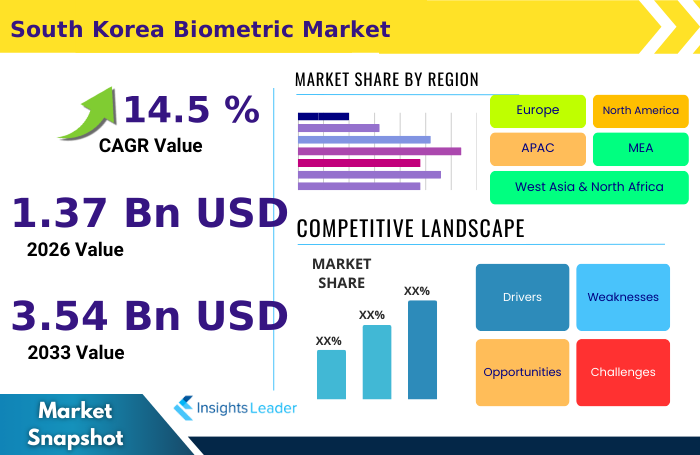
The South Korea Biometric Market Size in 2026 is estimated to be $1.37 Billion
What is the Growth Rate (CAGR) of South Korea Biometric Market?
The South Korea Biometric Market is expected to grow at 14.5% CAGR
What is the Market Size of the South Korea Biometric in 2033?
The South Korea Biometric Market Size in 2033 is estimated to be $3.54 Billion
Report Snapshot
| Report Attributes | Report Details |
|---|---|
| Forecast Year | 2033 |
| CAGR | 14.5% |
| History Year | 2016-2024 |
| Market Size in 2026 | $1.37 Billion |
| Market Size in 2033 | $3.54 Billion |
What are DRO & Impact Forces of South Korea Biometric Market?
Drivers include the increasing governmental emphasis on digital security, mandatory biometric integration in smart city infrastructure projects, and the high penetration rate of mobile and digital banking requiring strong authentication methods. Restraints involve stringent data privacy regulations (such as those managed by the Personal Information Protection Commission) and high initial deployment costs for advanced systems. Opportunities lie in integrating multi-modal biometrics for high-security applications in finance and defense.
What is Impact of US Tariffs on South Korea Biometric Market?
The direct impact is limited as South Korea maintains robust domestic manufacturing capabilities for hardware and semiconductors. However, indirect impacts arise from increased global pricing pressure on specialized sensor components sourced internationally, potentially raising procurement costs for advanced facial recognition and iris scanning equipment. This encourages diversification away from US-based component suppliers toward regional Asian partners to maintain competitive pricing and supply chain resilience within the biometric ecosystem.
How is AI currently impacting South Korea Biometric Market?
AI is fundamentally transforming the market by significantly enhancing accuracy and reducing false rejection rates, particularly in complex scenarios involving poor lighting or partial scans. Machine learning algorithms enable real-time liveness detection (anti-spoofing) and predictive security analytics, which are crucial for high-traffic environments like airports and large corporate facilities. This AI integration supports the transition from single-factor to multi-modal biometric solutions, boosting trust and deployment in critical national infrastructure sectors.
South Korea Biometric Market Research Report – Table of Contents
1. Executive Summary
2. Introduction & Research Objectives
3. Scope of the Study
4. Research Methodology of South Korea Biometric Market
5. South Korea Biometric Market Overview & Industry Background
6. South Korea Biometric Market Size & Forecast Analysis
7. South Korea Biometric Market Segmentation Analysis
8. Competitive Landscape
9. Consumer Behavior & Demand Analysis
10. Pricing & Cost Structure Analysis
11. South Korea Biometric Market Drivers, Challenges & Risks
12. Regulatory & Policy Framework
13. Technology & Innovation Impact
14. Strategic Insights & Recommendations
15. Conclusion & Future Outlook
For more queries, kindly contact [email protected]