Argentina Smart Manufacturing Market Size and Insights – 2026 to 2033
Report ID : IL_6842 | Report Language's : En/Jp/Fr/De | Publisher : IL |
Format : 


What is the Market Size of the Argentina Smart Manufacturing in 2026?
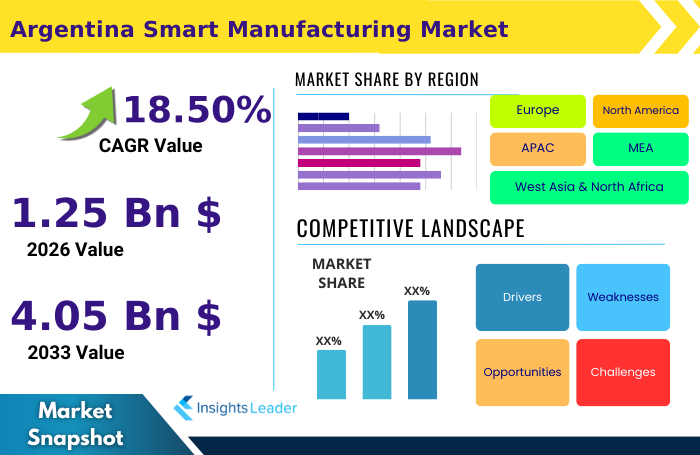
The Argentina Smart Manufacturing Market Size in 2026 is estimated to be USD 1.25 Billion
What is the Growth Rate (CAGR) of Argentina Smart Manufacturing Market?
The Argentina Smart Manufacturing Market is expected to grow at 18.5% CAGR
What is the Market Size of the Argentina Smart Manufacturing in 2033?
The Argentina Smart Manufacturing Market Size in 2033 is estimated to be USD 4.05 Billion
What are DRO and Impact Forces of Argentina Smart Manufacturing Market?
Drivers include the necessity for operational efficiency, government initiatives promoting Industry 4.0 adoption, and increasing foreign direct investment in technology. Restraints involve significant economic volatility in Argentina, high initial capital expenditure requirements, and a persistent shortage of specialized technical talent capable of deploying advanced systems. Opportunities are derived from the modernization of aging industrial infrastructure and the potential for vertical integration across key sectors like automotive and food processing.
What is Impact of U.S. Tariffs on Argentina Smart Manufacturing Market?
The primary impact of US tariffs includes global supply chain reconfiguration and increased volatility in commodity pricing, indirectly affecting Argentinian manufacturers reliant on imported components. While direct tariffs on Argentina are limited, the resulting shift in global trade patterns can either present opportunities for local sourcing substitution or inflate input costs due to increased regional competition. This dynamic pressures local firms to accelerate digitalization to mitigate cost increases through efficiency.
How is AI currently impacting Argentina Smart Manufacturing Market?
AI is fundamentally transforming global manufacturing through enhanced automation, predictive maintenance capabilities that minimize downtime, and sophisticated quality control systems. It enables hyper-personalization of products and optimizes complex logistical networks, leading to significant reductions in waste and energy consumption. Furthermore, generative AI is accelerating product design cycles and optimizing factory layouts for maximum throughput.