Asia-Pacific Automated Test Equipment (ATE) Market Size and Insights – 2026 to 2033
Report ID : IL_17011 | Report Language's : En/Jp/Fr/De | Publisher : IL |
Format : 



What is the Market Size of the Asia-Pacific Automated Test Equipment (ATE) in 2026?
The Asia-Pacific Automated Test Equipment (ATE) Market Size in 2026 is estimated to be $4.00 Billion USD
What is the Growth Rate (CAGR) of Asia-Pacific Automated Test Equipment (ATE) Market?
The Asia-Pacific Automated Test Equipment (ATE) Market is expected to grow at 7.5% CAGR
What is the Market Size of the Asia-Pacific Automated Test Equipment (ATE) in 2033?
The Asia-Pacific Automated Test Equipment (ATE) Market Size in 2033 is estimated to be $6.63 Billion USD
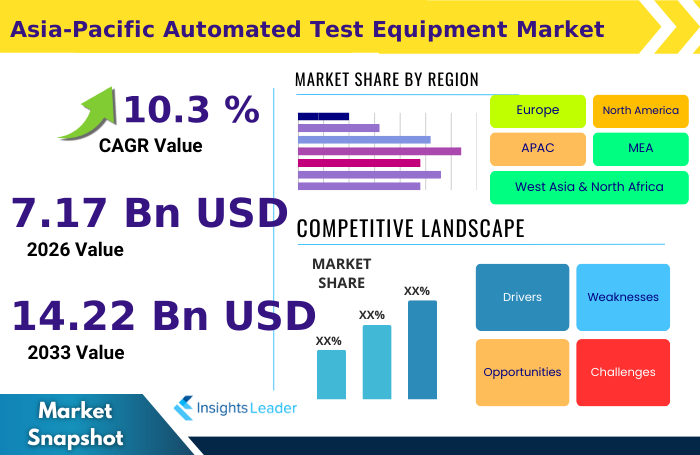
Report Snapshot
| Report Attributes | Report Details |
|---|---|
| Forecast Year | 2033 |
| CAGR | 7.5% |
| History Year | 2016-2024 |
| Market Size in 2026 | 4.00 Billion USD$ |
| Market Size in 2033 | 6.63 Billion USD$ |
What are DRO & Impact Forces of Asia-Pacific Automated Test Equipment (ATE) Market?
Drivers include the massive expansion of the semiconductor industry, propelled by 5G deployment, IoT proliferation, and significant government backing for indigenous chip manufacturing capabilities across APAC nations such as China, South Korea, and Taiwan.Restraints are primarily linked to the high capital expenditure required for advanced ATE procurement and the complex regulatory and technological barrier to entry for new players, alongside persistent geopolitical trade tensions affecting supply chains.Opportunities lie in integrating artificial intelligence (AI) and machine learning (ML) for predictive testing and leveraging the rapid growth of the automotive electronics segment, specifically in electric vehicles (EVs) and Advanced Driver-Assistance Systems (ADAS).
What is Impact of US Tariffs on Asia-Pacific Automated Test Equipment (ATE) Market?
U.S. tariffs and export controls introduce significant volatility and uncertainty in the procurement cycle for high-end ATE systems, particularly impacting major manufacturing hubs that rely heavily on American technology and specialized components.The resulting geopolitical tensions compel APAC manufacturers, particularly those in China, to accelerate efforts toward developing domestic ATE solutions, which, while reducing dependency long-term, creates short-term operational hurdles and fragmented standards.This environment forces regional diversification of the supply chain, increasing both manufacturing costs and lead times for sophisticated testing equipment necessary for cutting-edge semiconductor nodes.
How is AI currently impacting Asia-Pacific Automated Test Equipment (ATE) Market?
AI is fundamentally transforming the ATE sector by integrating sophisticated machine learning algorithms to optimize test pattern generation, significantly reducing overall test time while maximizing fault coverage across complex chips. AI facilitates automated fault diagnosis and classification, allowing manufacturers to quickly identify and isolate defects, thereby improving yield rates and operational efficiency across high-volume production lines. Furthermore, AI-driven predictive maintenance capabilities are employed to monitor ATE health, minimizing unexpected downtime and prolonging equipment lifespan, which is critical given the high investment cost of these systems.
Asia-Pacific Automated Test Equipment (ATE) Market Research Report – Table of Contents
1. Executive Summary
2. Introduction & Research Objectives
3. Scope of the Study
4. Research Methodology of Asia-Pacific Automated Test Equipment (ATE) Market
5. Asia-Pacific Automated Test Equipment (ATE) Market Overview & Industry Background
6. Asia-Pacific Automated Test Equipment (ATE) Market Size & Forecast Analysis
7. Asia-Pacific Automated Test Equipment (ATE) Market Segmentation Analysis
8. Competitive Landscape
9. Consumer Behavior & Demand Analysis
10. Pricing & Cost Structure Analysis
11. Asia-Pacific Automated Test Equipment (ATE) Market Drivers, Challenges & Risks
12. Regulatory & Policy Framework
13. Technology & Innovation Impact
14. Strategic Insights & Recommendations
15. Conclusion & Future Outlook
For more queries, kindly contact [email protected]