Asia-Pacific Cable Modem Termination System (CMTS) Market Size and Insights – 2026 to 2033
Report ID : IL_11000 | Report Language's : En/Jp/Fr/De | Publisher : IL |
Format : 


What is the Market Size of the Asia-Pacific Cable Modem Termination System (CMTS) in 2026?
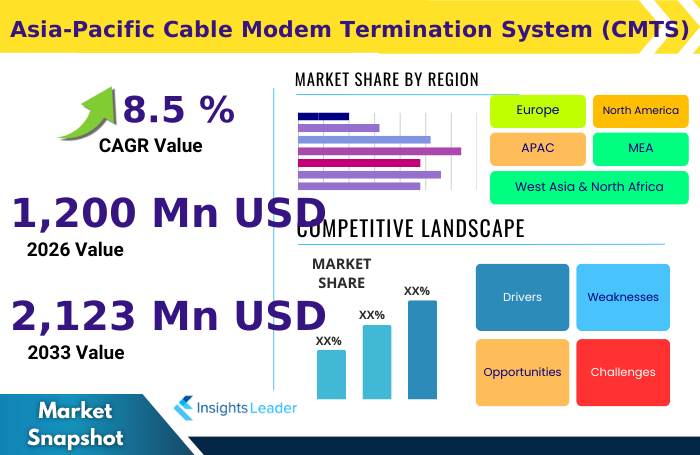
The Asia-Pacific Cable Modem Termination System (CMTS) Market Size in 2026 is estimated to be USD 1,200 Million
What is the Growth Rate (CAGR) of Asia-Pacific Cable Modem Termination System (CMTS) Market?
The Asia-Pacific Cable Modem Termination System (CMTS) Market is expected to grow at 8.5% CAGR
What is the Market Size of the Asia-Pacific Cable Modem Termination System (CMTS) in 2033?
The Asia-Pacific Cable Modem Termination System (CMTS) Market Size in 2033 is estimated to be USD 2,123 Million
Report Snapshot
| Report Attributes | Report Details |
|---|---|
| Forecast Year | 2033 |
| CAGR | 8.5% |
| History Year | 2016-2024 |
| Market Size in 2026 | USD 1,200 Million |
| Market Size in 2033 | USD 2,123 Million |
What are DRO and Impact Forces of Asia-Pacific Cable Modem Termination System (CMTS) Market?
DRO stands for Drivers, Restraints, and Opportunities, which collectively analyze the internal market dynamics shaping growth trajectories. Impact forces include external macroeconomic, geopolitical, and technological factors that influence the CMTS market environment. Key drivers include the widespread adoption of DOCSIS 3.1 and 4.0 standards and increasing demand for higher bandwidth services in emerging APAC economies, while restraints involve the long-term competition posed by Fiber-to-the-Home (FTTH) infrastructure rollouts.
What is Impact of U.S. Tariffs on Asia-Pacific Cable Modem Termination System (CMTS) Market?
The persistent US tariffs on Chinese manufactured goods impact the CMTS market primarily through increased hardware and component costs, as a significant portion of telecommunications infrastructure equipment is manufactured or relies on supply chains routed through the region. This cost increase affects the capital expenditure budgets of Cable Multiple-System Operators (MSOs) operating within the APAC region, potentially delaying infrastructure upgrade cycles toward Distributed Access Architectures (DAA). Furthermore, tariff uncertainty complicates long-term procurement planning and necessitates diversification of supply chains, creating geopolitical risk considerations for market leaders.
How is AI currently impacting Asia-Pacific Cable Modem Termination System (CMTS) Market?
AI is fundamentally transforming global industries through enhanced operational efficiency, predictive analytics, and hyper-personalization of services across verticals such as telecommunications, finance, healthcare, and manufacturing. In the CMTS sector specifically, AI is being deployed for network optimization, automated fault detection, proactive maintenance scheduling, and optimizing bandwidth allocation in real-time to improve quality of service (QoS) for subscribers. This technological integration leads to reduced latency and improved overall network reliability and performance management worldwide.
Asia-Pacific Cable Modem Termination System (CMTS) Market Research Report – Table of Contents
1. Executive Summary
2. Introduction & Research Objectives
3. Scope of the Study
4. Research Methodology of Asia-Pacific Cable Modem Termination System (CMTS) Market
5. Asia-Pacific Cable Modem Termination System (CMTS) Market Overview & Industry Background
6. Asia-Pacific Cable Modem Termination System (CMTS) Market Size & Forecast Analysis
7. Asia-Pacific Cable Modem Termination System (CMTS) Market Segmentation Analysis
8. Competitive Landscape
9. Consumer Behavior & Demand Analysis
10. Pricing & Cost Structure Analysis
11. Asia-Pacific Cable Modem Termination System (CMTS) Market Drivers, Challenges & Risks
12. Regulatory & Policy Framework
13. Technology & Innovation Impact
14. Strategic Insights & Recommendations
15. Conclusion & Future Outlook
For more queries, kindly contact [email protected]