Asia-Pacific Smart Manufacturing Market Size and Insights – 2026 to 2033
Report ID : IL_6802 | Report Language's : En/Jp/Fr/De | Publisher : IL |
Format : 


What is the Market Size of the Asia-Pacific Smart Manufacturing in 2026?
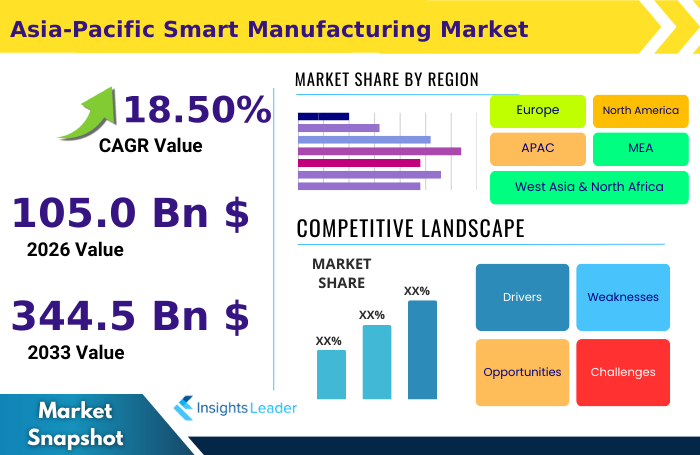
The Asia-Pacific Smart Manufacturing Market Size in 2026 is estimated to be 105.0 Billion USD
What is the Growth Rate (CAGR) of Asia-Pacific Smart Manufacturing Market?
The Asia-Pacific Smart Manufacturing Market is expected to grow at 18.5% CAGR
What is the Market Size of the Asia-Pacific Smart Manufacturing in 2033?
The Asia-Pacific Smart Manufacturing Market Size in 2033 is estimated to be 344.5 Billion USD
What are DRO and Impact Forces of Asia-Pacific Smart Manufacturing Market?
Drivers include substantial government support for industrial automation and rapid adoption of Industry 4.0 standards across key economies like China, Japan, and South Korea. Restraints involve the high initial capital expenditure required for system integration and the shortage of skilled labor capable of maintaining complex smart infrastructure. Opportunities are centered on the widespread deployment of 5G networks, enabling low-latency communication crucial for real-time factory operations.
What is Impact of U.S. Tariffs on Asia-Pacific Smart Manufacturing Market?
The implementation of US tariffs has led to significant restructuring of global and Asia-Pacific supply chains, accelerating the shift of manufacturing operations away from traditional hubs. This has prompted manufacturers to invest heavily in smart factory technologies in emerging APac nations (e.g., Vietnam, India) to maintain cost efficiencies and mitigate geopolitical risks. Tariffs have indirectly boosted domestic technological adoption as firms seek localized supply chain resilience.
How is AI currently impacting Asia-Pacific Smart Manufacturing Market?
AI is fundamentally transforming global industries by enabling predictive maintenance, dramatically reducing downtime and operational costs. It facilitates highly accurate demand forecasting, optimizing inventory management and production scheduling. Furthermore, AI powers sophisticated quality control systems through computer vision, ensuring higher product consistency and driving autonomous decision-making within complex industrial processes globally.