Belgium Smart Manufacturing Market Size and Insights – 2026 to 2033
Report ID : IL_6722 | Report Language's : En/Jp/Fr/De | Publisher : IL |
Format : 



What is the Market Size of the Belgium Smart Manufacturing in 2026?
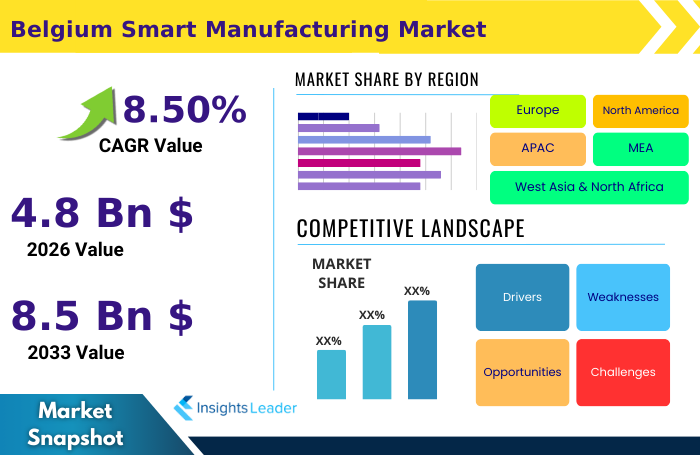
The Belgium Smart Manufacturing Market Size in 2026 is estimated to be $4.8 Billion
What is the Growth Rate (CAGR) of Belgium Smart Manufacturing Market?
The Belgium Smart Manufacturing Market is expected to grow at 8.5% CAGR
What is the Market Size of the Belgium Smart Manufacturing in 2033?
The Belgium Smart Manufacturing Market Size in 2033 is estimated to be $8.5 Billion
What are DRO and Impact Forces of Belgium Smart Manufacturing Market?
Drivers (D): Strong government initiatives supporting Industry 4.0 adoption, high labor costs encouraging automation investment, and the strategic importance of the chemical and pharmaceutical sectors in Belgium. Restraints (R): Significant initial capital expenditure required for large-scale digital transformation and persistent concerns regarding operational cybersecurity vulnerability. Opportunities (O): Expansion of 5G network integration into industrial environments and increasing demand for highly personalized, small-batch manufacturing capabilities.
What is Impact of U.S. Tariffs on Belgium Smart Manufacturing Market?
While Belgium, as a key EU member, faces indirect impacts, US tariffs primarily affect specific export-oriented sectors, particularly those involved in global automotive supply chains and steel/aluminum processing. The uncertainty caused by tariffs accelerates the need for supply chain resilience and localized, flexible manufacturing solutions, thereby boosting investment in smart technologies that minimize reliance on volatile international logistics.
How is AI currently impacting Belgium Smart Manufacturing Market?
Artificial Intelligence (AI) is fundamentally transforming industrial operations worldwide by enabling predictive maintenance, optimizing complex production scheduling in real-time, and facilitating highly accurate automated quality inspection. This impact leads to substantial operational cost reductions, minimization of downtime, and the creation of hyper-personalized product development cycles across global manufacturing ecosystems.