Canada Smart Manufacturing Market Size and Insights – 2026 to 2033
Report ID : IL_6642 | Report Language's : En/Jp/Fr/De | Publisher : IL |
Format : 


What is the Market Size of the Canada Smart Manufacturing in 2026?
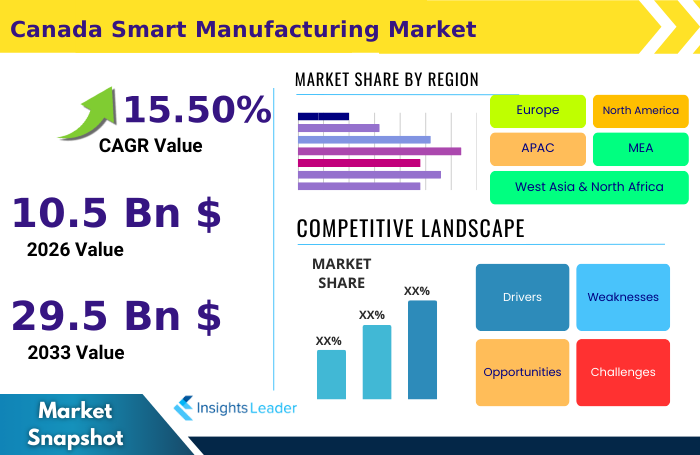
The Canada Smart Manufacturing Market Size in 2026 is estimated to be USD 10.5 Billion
What is the Growth Rate (CAGR) of Canada Smart Manufacturing Market?
The Canada Smart Manufacturing Market is expected to grow at 15.5% CAGR
What is the Market Size of the Canada Smart Manufacturing in 2033?
The Canada Smart Manufacturing Market Size in 2033 is estimated to be USD 29.5 Billion
What are DRO and Impact Forces of Canada Smart Manufacturing Market?
DRO refers to Drivers, Restraints, and Opportunities. Key drivers include government support for Industry 4.0 adoption and increasing demand for localized, efficient production. Restraints involve the high initial capital investment required and the persistent shortage of skilled labor specializing in advanced automation and data science. Opportunities focus on the expansion of predictive maintenance, digital twin technologies, and personalized mass customization models.
What is Impact of U.S. Tariffs on Canada Smart Manufacturing Market?
US tariffs and subsequent retaliatory measures significantly increase the complexity and cost of cross-border supply chains for Canadian manufacturers, leading to increased focus on operational efficiency. This financial pressure accelerates the adoption of smart manufacturing solutions, such as localized automation and flexible robotics, to mitigate rising input costs and reduce dependence on volatile international logistics. Furthermore, enhanced efficiency allows Canadian companies to maintain price competitiveness in global markets despite trade barriers.
How is AI currently impacting Canada Smart Manufacturing Market?
AI is fundamentally transforming global industries by enabling advanced process automation, optimizing complex supply chains, and driving superior predictive analytics capabilities. Its influence spans from manufacturing, where it facilitates highly accurate quality control and predictive maintenance, to healthcare, where it accelerates drug discovery and personalized medicine delivery. The current impact is characterized by increased productivity, reduced operational downtime, and the ability to handle massive, disparate data sets for real-time decision-making.