China Smart Manufacturing Market Size and Insights – 2026 to 2033
Report ID : IL_6602 | Report Language's : En/Jp/Fr/De | Publisher : IL |
Format : 


What is the Market Size of the China Smart Manufacturing in 2026?
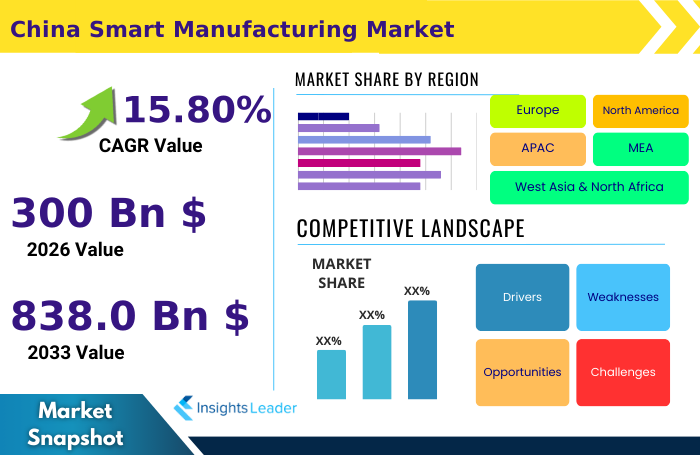
The China Smart Manufacturing Market Size in 2026 is estimated to be $300 Billion
What is the Growth Rate (CAGR) of China Smart Manufacturing Market?
The China Smart Manufacturing Market is expected to grow at CAGR 15.8%
What is the Market Size of the China Smart Manufacturing in 2033?
The China Smart Manufacturing Market Size in 2033 is estimated to be $838.0 Billion
What are DRO and Impact Forces of China Smart Manufacturing Market?
Drivers include substantial government investments (Made in China 2025), high industrial automation demand, and the urgent need for enhanced supply chain resilience. Restraints encompass the high initial capital expenditure for implementation and the persistent challenges related to cybersecurity protocols. Opportunities are found in 5G integration for industrial IoT (IIoT) and the development of localized software solutions, while impact forces involve geopolitical tensions accelerating domestic self-reliance.
What is Impact of U.S. Tariffs on China Smart Manufacturing Market?
The persistent imposition of US tariffs has significantly reshaped the supply chain architecture for Chinese manufacturers, encouraging a shift towards increased domestic component sourcing and production localization. This economic pressure drives accelerated investment in smart manufacturing technologies aimed at boosting internal efficiency, thereby offsetting higher costs associated with trade friction. Furthermore, it fosters market diversification away from heavily affected trade routes and incentivizes internal innovation within high-tech sectors critical for industrial independence.
How is AI currently impacting China Smart Manufacturing Market?
AI is fundamentally transforming global industries by enabling predictive maintenance, optimizing complex logistics networks, and automating routine decision-making processes across operational levels. This results in significant improvements in operational efficiency, reduction of downtime, and the creation of highly personalized customer experiences. Key impacts are visible in enhanced productivity, streamlined data analysis for quality control, and the acceleration of research and development cycles across pharmaceuticals, automotive, and technology sectors.