Denmark Carbon Credits Market Size and Insights – 2026 to 2033
Report ID : IL_6546 | Report Language's : En/Jp/Fr/De | Publisher : IL |
Format : 


What is the Market Size of the Denmark Carbon Credits in 2026?
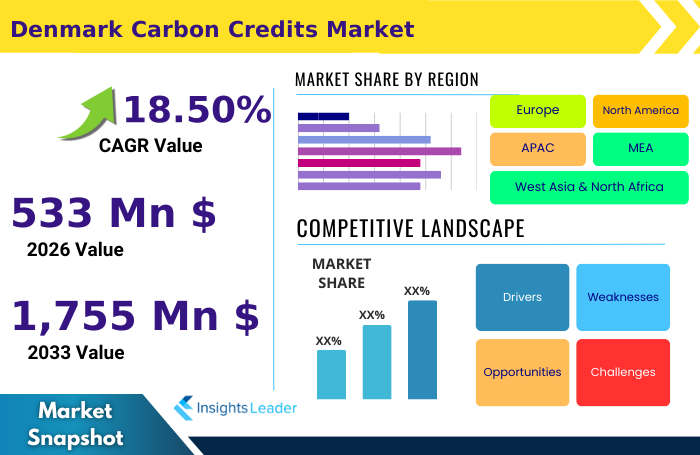
The Denmark Carbon Credits Market Size in 2026 is estimated to be USD 533 Million
What is the Growth Rate (CAGR) of Denmark Carbon Credits Market?
The Denmark Carbon Credits Market is expected to grow at 18.5% CAGR
What is the Market Size of the Denmark Carbon Credits in 2033?
The Denmark Carbon Credits Market Size in 2033 is estimated to be USD 1,755 Million
What are DRO and Impact Forces of Denmark Carbon Credits Market?
The market drivers include stringent implementation of the EU Emissions Trading System (ETS) and Denmark’s highly ambitious national climate neutrality targets, increasing corporate demand for compliance and voluntary offsets. Restraints primarily involve the high upfront costs associated with carbon capture and storage (CCS) and sustainable project development. Opportunities lie in the expansion of the voluntary carbon market and the potential integration of blue carbon initiatives within Danish maritime sectors.
What is Impact of U.S. Tariffs on Denmark Carbon Credits Market?
While direct US tariffs on goods generally have minimal immediate effect on the pricing structure of the localized EU ETS, they indirectly influence the carbon credits market by affecting the competitiveness of Danish exporters. Increased supply chain disruptions stemming from global trade tensions may raise operational costs for carbon-intensive industries, potentially boosting internal demand for domestic emission reduction projects to maintain compliance and mitigate future Carbon Border Adjustment Mechanism (CBAM) risks.
How is AI currently impacting Denmark Carbon Credits Market?
Artificial Intelligence is revolutionizing industries globally by enabling precise predictive modeling for energy consumption and emissions forecasting, leading to optimized resource allocation. It is essential in enhancing the accuracy and efficiency of Measurement, Reporting, and Verification (MRV) systems, drastically improving the credibility of carbon credits. Furthermore, AI drives innovation in smart grid management and the scaling of sustainable energy infrastructure.