Europe Contact Lenses Market Size and Insights – 2026 to 2033
Report ID : IL_6493 | Report Language's : En/Jp/Fr/De | Publisher : IL |
Format : 


What is the Market Size of the Europe Contact Lenses in 2026?
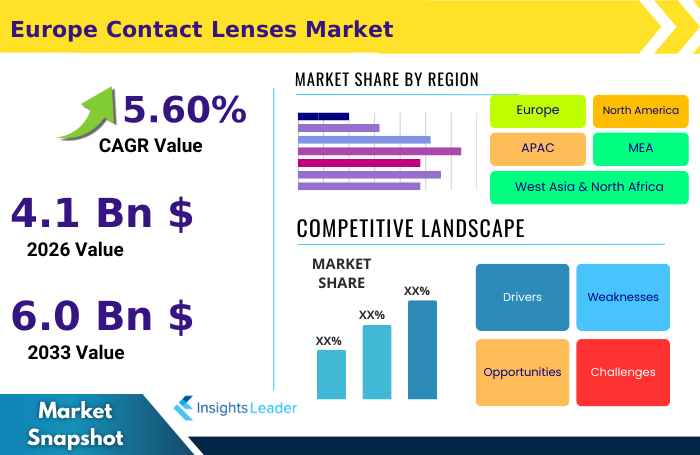
The Europe Contact Lenses Market Size in 2026 is estimated to be 4.1 Billion USD
What is the Growth Rate (CAGR) of Europe Contact Lenses Market?
The Europe Contact Lenses Market is expected to grow at 5.6% CAGR
What is the Market Size of the Europe Contact Lenses in 2033?
The Europe Contact Lenses Market Size in 2033 is estimated to be 6.0 Billion USD
What are DRO and Impact Forces of Europe Contact Lenses Market?
Disruptive Regulatory Oversight (DRO) refers to sudden, significant changes in regulatory environments, such as new European Union Medical Device Regulations (MDR), which can disrupt existing market strategies and require substantial investment in compliance and clinical data. Impact Forces encompass macroeconomic, geopolitical, and technological shifts that alter market dynamics, including inflation, supply chain instability, or rapid advancements in ophthalmic technology. These forces require proactive risk management and adaptation strategies from market participants.
What is Impact of U.S. Tariffs on Europe Contact Lenses Market?
While the Europe Contact Lenses Market is primarily governed by EU regulations, the impact of US tariffs on global supply chains remains significant, particularly for raw materials (such as silicone hydrogel polymers) and manufacturing equipment sourced internationally. Increased tariffs in the US often lead to higher global procurement costs for multinational corporations that serve the European market, potentially inflating the Cost of Goods Sold (COGS). This indirect financial pressure can be passed onto European consumers or affect the profit margins of distributors and manufacturers operating within the region.
How is AI currently impacting Europe Contact Lenses Market?
Artificial Intelligence (AI) is transforming industries globally by optimizing operational efficiency, accelerating research and development cycles, and enabling personalized customer experiences. In the contact lens sector, AI supports advanced diagnostic tools for precise prescriptions, enhances robotic manufacturing precision, and drives customized lens design based on patient biometric data, leading to better product performance and reduced waste.