Germany Industrial Ethernet Market Size and Insights – 2026 to 2033
Report ID : IL_3139 | Report Language's : En/Jp/Fr/De | Publisher : IL |
Format : 


What is the Market Size of the Germany Industrial Ethernet in 2026?
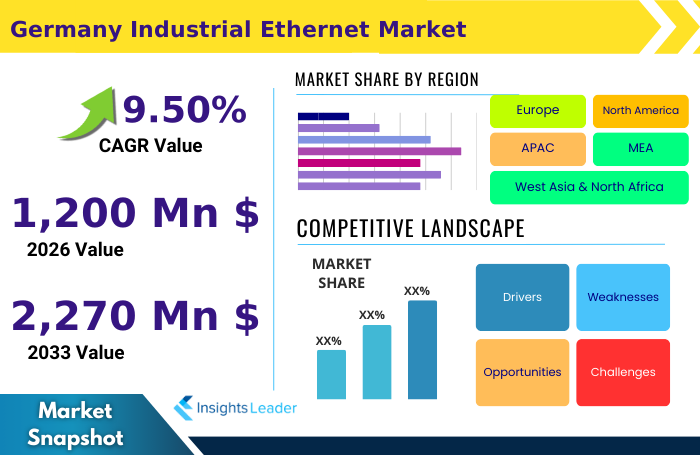
The Germany Industrial Ethernet Market Size in 2026 is estimated to be $1,200 Million USD
What is the Growth Rate (CAGR) of Germany Industrial Ethernet Market?
The Germany Industrial Ethernet Market is expected to grow at CAGR 9.5%
What is the Market Size of the Germany Industrial Ethernet in 2033?
The Germany Industrial Ethernet Market Size in 2033 is estimated to be $2,270 Million USD
What are DRO & Impact Forces?
Drivers include accelerated adoption of Industry 4.0 standards, mandated factory automation protocols, and the need for high-speed, secure data transmission. Restraints encompass the complexity and high initial capital expenditure associated with legacy system integration and profound cybersecurity threats. Opportunities are centered around the deployment of Time-Sensitive Networking (TSN) and seamless integration with advanced edge computing architectures, driving significant production efficiencies.
What is Impact of US tariffs?
US tariffs primarily exert influence through volatility in global semiconductor and electronic component supply chains critical for Industrial Ethernet infrastructure. While direct tariffs on final German goods are manageable, rising input costs and prolonged trade uncertainties lead to delays in major capital equipment purchasing and fluctuating pricing for components utilized by German original equipment manufacturers (OEMs). This necessitates strategic inventory management and localized sourcing diversification.
How is AI currently impacting industries globally?
AI is fundamentally redefining industrial operations worldwide by enabling highly accurate predictive maintenance models, dramatically enhancing quality control through advanced machine vision systems, and optimizing intricate resource allocation across extended supply networks. Globally, the integration of AI within industrial ecosystems yields substantial operational efficiency improvements, commonly ranging between 15% to 25%, while significantly mitigating instances of expensive, unplanned operational downtime.