Indonesia Building Integrated Photovoltaics (BIPV) Market Size and Insights – 2026 to 2033
Report ID : IL_8205 | Report Language's : En/Jp/Fr/De | Publisher : IL |
Format : 


What is the Market Size of the Indonesia Building Integrated Photovoltaics (BIPV) in 2026?
The Indonesia Building Integrated Photovoltaics (BIPV) Market Size in 2026 is estimated to be $55.0 Million
What is the Growth Rate (CAGR) of Indonesia Building Integrated Photovoltaics (BIPV) Market?
The Indonesia Building Integrated Photovoltaics (BIPV) Market is expected to grow at CAGR 18.5%
What is the Market Size of the Indonesia Building Integrated Photovoltaics (BIPV) in 2033?
The Indonesia Building Integrated Photovoltaics (BIPV) Market Size in 2033 is estimated to be $185.0 Million
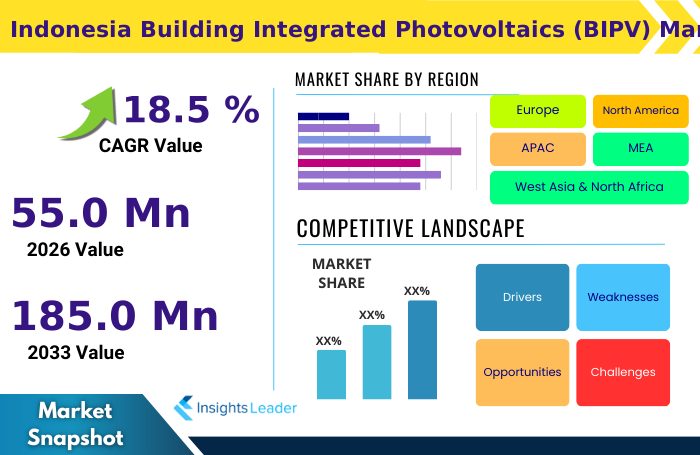
Report Snapshot
| Report Attributes | Report Details |
|---|---|
| Forecast Year | 2033 |
| CAGR | 18.5% |
| History Year | 2016-2024 |
| Market Size in 2026 | 55.0 Million |
| Market Size in 2033 | 185.0 Million |
What are DRO and Impact Forces of Indonesia Building Integrated Photovoltaics (BIPV) Market?
DRO stands for Drivers, Restraints, and Opportunities, the core analytical framework identifying the primary forces influencing market dynamics. Drivers are positive factors propelling growth (e.g., government incentives, urbanization). Restraints are inhibiting factors (e.g., high upfront costs, regulatory hurdles). Opportunities are external market conditions that can be leveraged (e.g., technological advancements, new application areas). Impact forces specifically quantify the magnitude and direction of these elements on market valuation and growth trajectory, crucial for strategic planning and risk assessment.
What is Impact of U.S. Tariffs on Indonesia Building Integrated Photovoltaics (BIPV) Market?
The impact of US tariffs on solar components, while not directly aimed at Indonesian exports, causes global supply chain redirection. This redirection can lead to increased availability of cheaper, non-US bound components in Southeast Asia, potentially lowering BIPV installation costs in the short term, thereby boosting regional competitiveness. Conversely, overall global trade uncertainty and supply instability can hinder long-term investment and stability, though Indonesia’s focus on insulating domestic manufacturing mitigates some direct negative supply chain effects.
How is AI currently impacting Indonesia Building Integrated Photovoltaics (BIPV) Market?
AI is fundamentally transforming global industries through enhanced predictive analytics, hyper-automation, and operational optimization. It drives significant efficiency gains in manufacturing (Industry 4.0), revolutionizes customer experience, and accelerates complex R&D processes, particularly in material science crucial for BIPV development. Globally, AI’s major impact is seen in creating hyper-efficient supply chains, enabling predictive maintenance across physical assets, and providing crucial data-driven decision support systems that enhance strategic agility across finance, healthcare, and energy sectors.
Indonesia Building Integrated Photovoltaics (BIPV) Market Research Report – Table of Contents
1. Executive Summary
2. Introduction & Research Objectives
3. Scope of the Study
4. Research Methodology of Indonesia Building Integrated Photovoltaics (BIPV) Market
5. Indonesia Building Integrated Photovoltaics (BIPV) Market Overview & Industry Background
6. Indonesia Building Integrated Photovoltaics (BIPV) Market Size & Forecast Analysis
7. Indonesia Building Integrated Photovoltaics (BIPV) Market Segmentation Analysis
8. Competitive Landscape
9. Consumer Behavior & Demand Analysis
10. Pricing & Cost Structure Analysis
11. Indonesia Building Integrated Photovoltaics (BIPV) Market Drivers, Challenges & Risks
12. Regulatory & Policy Framework
13. Technology & Innovation Impact
14. Strategic Insights & Recommendations
15. Conclusion & Future Outlook
For more queries, kindly contact [email protected]