Indonesia Microbial fuel cells (MFC) Market Size and Insights – 2026 to 2033
Report ID : IL_16572 | Report Language's : En/Jp/Fr/De | Publisher : IL |
Format : 


What is the Market Size of the Indonesia Microbial fuel cells (MFC) in 2026?
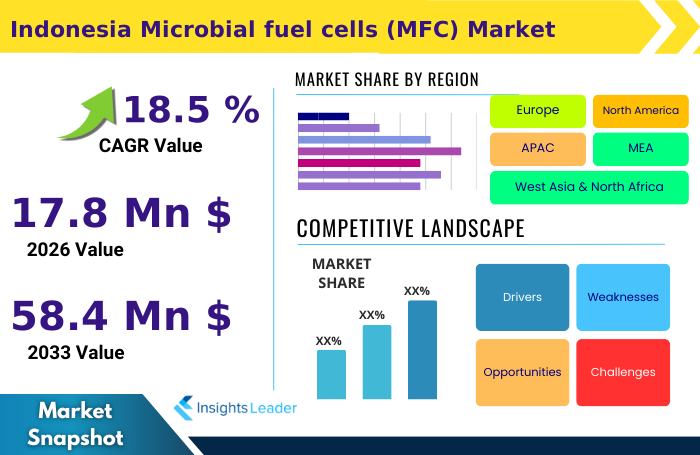
The Indonesia Microbial fuel cells (MFC) Market Size in 2026 is estimated to be USD 17.8 Million
What is the Growth Rate (CAGR) of Indonesia Microbial fuel cells (MFC) Market?
The Indonesia Microbial fuel cells (MFC) Market is expected to grow at CAGR 18.5%
What is the Market Size of the Indonesia Microbial fuel cells (MFC) in 2033?
The Indonesia Microbial fuel cells (MFC) Market Size in 2033 is estimated to be USD 58.4 Million
Report Snapshot
| Report Attributes | Report Details |
|---|---|
| Forecast Year | 2033 |
| CAGR | 18.5% |
| History Year | 2016-2024 |
| Market Size in 2026 | 17.8 Million USD$ |
| Market Size in 2033 | 58.4 Million USD$ |
What are DRO & Impact Forces of Indonesia Microbial fuel cells (MFC) Market?
Drivers include Indonesia’s critical need for decentralized wastewater treatment and off-grid power generation, supported by government initiatives promoting sustainable technologies. Restraints involve the current high cost of specialized membranes and electrode materials, coupled with low power density compared to traditional batteries, limiting large-scale commercial viability. Opportunities exist in scaling down MFC technology for remote monitoring sensors and expanding academic-industrial collaboration for performance optimization.
What is Impact of US Tariffs on Indonesia Microbial fuel cells (MFC) Market?
The direct impact of U.S. tariffs on MFC core components (like specialized proton exchange membranes or bio-anodes) is generally minimal, as sourcing tends to be global or domestic rather than solely U.S.-dependent. However, indirect impacts are noted through volatility in the global prices of electronic control systems and monitoring equipment imported for integrated MFC systems, potentially elevating operational expenditure for Indonesian developers. Furthermore, broader geopolitical tensions resulting from tariffs can affect foreign direct investment crucial for funding pilot projects in emerging sustainable energy sectors.
How is AI currently impacting Indonesia Microbial fuel cells (MFC) Market?
AI is enhancing the efficiency and reliability of MFC systems by enabling real-time monitoring and predictive analytics of biological processes. Machine learning algorithms optimize critical operational parameters such as substrate feeding rates, pH levels, and external resistance, maximizing power output and stability. This optimization reduces the necessity for constant human intervention, accelerating the transition of MFC technology from laboratory settings to commercial field deployment in areas like remote environmental sensing.
Indonesia Microbial fuel cells (MFC) Market Research Report – Table of Contents
1. Executive Summary
2. Introduction & Research Objectives
3. Scope of the Study
4. Research Methodology of Indonesia Microbial fuel cells (MFC) Market
5. Indonesia Microbial fuel cells (MFC) Market Overview & Industry Background
6. Indonesia Microbial fuel cells (MFC) Market Size & Forecast Analysis
7. Indonesia Microbial fuel cells (MFC) Market Segmentation Analysis
8. Competitive Landscape
9. Consumer Behavior & Demand Analysis
10. Pricing & Cost Structure Analysis
11. Indonesia Microbial fuel cells (MFC) Market Drivers, Challenges & Risks
12. Regulatory & Policy Framework
13. Technology & Innovation Impact
14. Strategic Insights & Recommendations
15. Conclusion & Future Outlook
For more queries, kindly contact [email protected]