Poland Industrial Ethernet Market Size and Insights – 2026 to 2033
Report ID : IL_3039 | Report Language's : En/Jp/Fr/De | Publisher : IL |
Format : 


What is the Market Size of the Poland Industrial Ethernet in 2026?
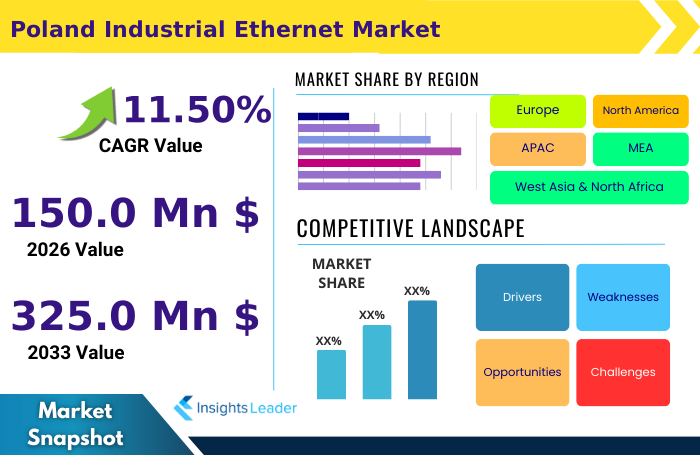
The Poland Industrial Ethernet Market Size in 2026 is estimated to be USD 150.0 Million
What is the Growth Rate (CAGR) of Poland Industrial Ethernet Market?
The Poland Industrial Ethernet Market is expected to grow at 11.5% CAGR
What is the Market Size of the Poland Industrial Ethernet in 2033?
The Poland Industrial Ethernet Market Size in 2033 is estimated to be USD 325.0 Million
What are DRO & Impact Forces?
DRO (Drivers, Restraints, Opportunities) define the dynamic factors influencing market growth. Drivers in Poland include the rapid integration of Industry 4.0 standards across manufacturing and logistics sectors, supported by robust EU funding for digitization.Restraints often involve high initial capital investment costs for network overhaul and a shortage of skilled personnel trained in managing complex Industrial IoT infrastructure and cybersecurity protocols specific to operational technology (OT) environments.Opportunities center around expansion into specialized industrial segments like automotive manufacturing and pharmaceuticals, demanding high-speed, deterministic communication protocols inherent to Industrial Ethernet systems.
What is Impact of US tariffs?
The primary impact of US tariffs on the Poland Industrial Ethernet market is indirect, affecting global supply chains for crucial networking hardware, semiconductor components, and industrial automation equipment sourced globally.Increased material costs and extended lead times for highly specialized switches, controllers, and field devices can compress manufacturer margins and potentially delay large-scale infrastructure deployment projects within Poland.However, Poland’s reliance on the EU internal market and specific trade agreements often buffers it against direct tariff volatility, focusing the supply challenge mainly on specialized imported components.
How is AI currently impacting industries globally?
AI is fundamentally reshaping industrial operations globally by enabling predictive maintenance, optimizing supply chain logistics, and enhancing quality control through advanced machine vision systems, requiring reliable, high-bandwidth data transmission. This necessitates the deployment of robust Industrial Ethernet networks capable of handling massive volumes of real-time operational data. AI algorithms rely heavily on the deterministic nature of Industrial Ethernet protocols to ensure minimal latency and jitter, critical for complex closed-loop control systems.