Singapore Smart Manufacturing Market Size and Insights – 2026 to 2033
Report ID : IL_5962 | Report Language's : En/Jp/Fr/De | Publisher : IL |
Format : 


What is the Market Size of the Singapore Smart Manufacturing in 2026?
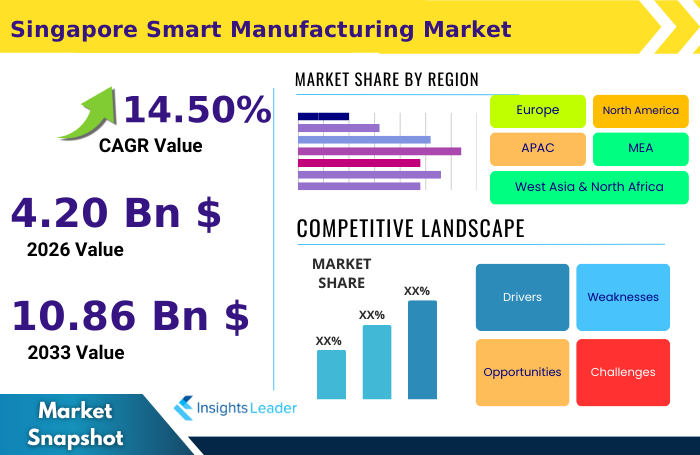
The Singapore Smart Manufacturing Market Size in 2026 is estimated to be USD 4.20 Billion
What is the Growth Rate (CAGR) of Singapore Smart Manufacturing Market?
The Singapore Smart Manufacturing Market is expected to grow at 14.5% CAGR
What is the Market Size of the Singapore Smart Manufacturing in 2033?
The Singapore Smart Manufacturing Market Size in 2033 is estimated to be USD 10.86 Billion
What are DRO and Impact Forces of Singapore Smart Manufacturing Market?
Drivers (D): Robust government support (e.g., Industry 4.0 initiatives) and high regional demand for advanced electronics and pharmaceuticals. Restraints (R): High operational costs in Singapore, coupled with the reliance on skilled talent in a competitive labor market. Opportunities (O): Expansion of 5G infrastructure and integration of Artificial Intelligence (AI) for real-time decision-making and predictive maintenance strategies.
What is Impact of U.S. Tariffs on Singapore Smart Manufacturing Market?
US tariffs contribute to global supply chain restructuring, which strategically positions Singapore as a reliable, high-trust manufacturing and R&D hub for companies seeking stable alternatives to traditional supply bases. However, trade friction increases price volatility for imported advanced materials and components necessary for high-tech manufacturing, potentially squeezing profit margins for locally based firms.
How is AI currently impacting Singapore Smart Manufacturing Market?
Artificial Intelligence is fundamentally transforming global industries by optimizing complex operational processes through predictive analytics, thereby enabling highly efficient production schedules and reducing unplanned downtime. Furthermore, AI facilitates mass customization and hyper-personalization in consumer goods, while automating cognitive tasks in sectors such as finance, healthcare, and logistics, leading to significant productivity gains and lower long-term labor costs.