South Korea Carbon Credits Market Size and Insights – 2026 to 2033
Report ID : IL_14879 | Report Language's : En/Jp/Fr/De | Publisher : IL |
Format : 


What is the Market Size of the South Korea Carbon Credits in 2026?
The South Korea Carbon Credits Market Size in 2026 is estimated to be $850 Million
What is the Growth Rate (CAGR) of South Korea Carbon Credits Market?
The South Korea Carbon Credits Market is expected to grow at 8.5% CAGR
What is the Market Size of the South Korea Carbon Credits in 2033?
The South Korea Carbon Credits Market Size in 2033 is estimated to be $1,550 Million
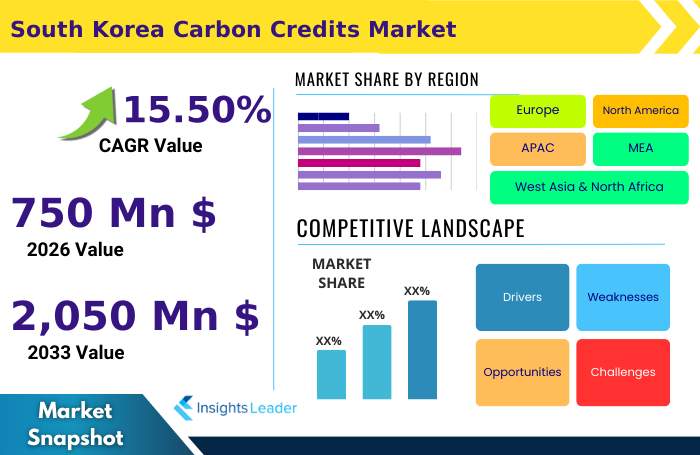
Report Snapshot
| Report Attributes | Report Details |
|---|---|
| Forecast Year | 2033 |
| CAGR | 8.5% |
| History Year | 2016-2024 |
| Market Size in 2026 | 850 Million USD |
| Market Size in 2033 | 1,550 Million USD |
What are DRO & Impact Forces of South Korea Carbon Credits Market?
Driving forces include stringent government emission targets under the NDC, the mandated participation of high-emitting sectors in the K-ETS, and increasing corporate demand for voluntary offsets. Opportunities arise from the potential linkage of the K-ETS with international markets and the expansion of domestic offset projects (KCUs). Restraints involve high volatility in auction prices and political pressures from industrial lobbies regarding compliance costs and allocation complexity.
What is Impact of US Tariffs on South Korea Carbon Credits Market?
While current U.S. tariffs focus primarily on non-environmental trade disputes, the emergence of carbon-related import fees (such as potential U.S. CBAM equivalents) would directly impact South Korean heavy industries. This pressure would force K-ETS participants to aggressively lower emissions intensity to maintain export competitiveness, consequently driving up the demand for high-quality KAU allowances and KCU credits within the domestic compliance market.
How is AI currently impacting South Korea Carbon Credits Market?
AI is significantly enhancing the precision of Measurement, Reporting, and Verification (MRV) processes for compliance entities, utilizing machine learning to predict carbon price trends, and optimizing the development cycle for offset projects. Furthermore, AI-driven energy management systems allow large emitters to minimize operational emissions, indirectly influencing their total allowance needs and market participation strategies.
South Korea Carbon Credits Market Research Report – Table of Contents
1. Executive Summary
2. Introduction & Research Objectives
3. Scope of the Study
4. Research Methodology of South Korea Carbon Credits Market
5. South Korea Carbon Credits Market Overview & Industry Background
6. South Korea Carbon Credits Market Size & Forecast Analysis
7. South Korea Carbon Credits Market Segmentation Analysis
8. Competitive Landscape
9. Consumer Behavior & Demand Analysis
10. Pricing & Cost Structure Analysis
11. South Korea Carbon Credits Market Drivers, Challenges & Risks
12. Regulatory & Policy Framework
13. Technology & Innovation Impact
14. Strategic Insights & Recommendations
15. Conclusion & Future Outlook
For more queries, kindly contact [email protected]