South Korea Smart Manufacturing Market Size and Insights – 2026 to 2033
Report ID : IL_5882 | Report Language's : En/Jp/Fr/De | Publisher : IL |
Format : 


What is the Market Size of the South Korea Smart Manufacturing in 2026?
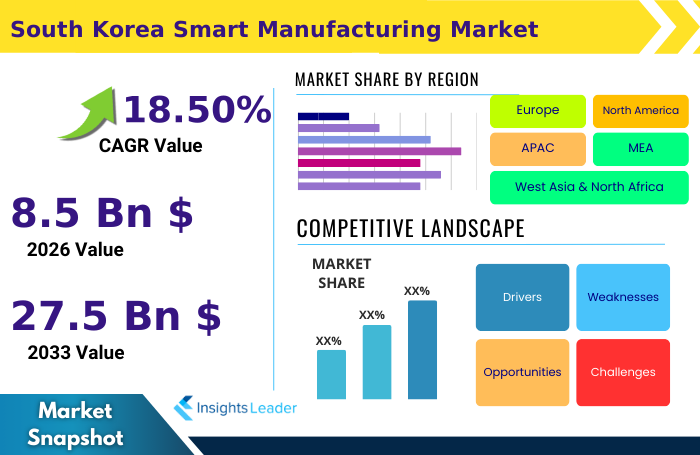
The South Korea Smart Manufacturing Market Size in 2026 is estimated to be USD 8.5 Billion
What is the Growth Rate (CAGR) of South Korea Smart Manufacturing Market?
The South Korea Smart Manufacturing Market is expected to grow at 18.5% CAGR
What is the Market Size of the South Korea Smart Manufacturing in 2033?
The South Korea Smart Manufacturing Market Size in 2033 is estimated to be USD 27.5 Billion
What are DRO and Impact Forces of South Korea Smart Manufacturing Market?
Disruptive Risks and Opportunities (DRO) define potential game-changing events that fundamentally alter market dynamics. Risks include cybersecurity threats to integrated networks and high initial capital expenditure. Opportunities are driven by robust government subsidies (e.g., Manufacturing Innovation 3.0 strategy) and rapid adoption of 5G infrastructure, accelerating data transfer and real-time operational optimization.
What is Impact of U.S. Tariffs on South Korea Smart Manufacturing Market?
US tariffs, primarily targeted at Chinese imports, have compelled South Korean manufacturers to strategically re-evaluate global supply chains. This pressure accelerates domestic smart factory investments, aiming for higher efficiency and localized production to mitigate geopolitical trade risks. It also promotes diversification into markets less affected by US-China tensions, positioning South Korea as a key high-tech manufacturing hub outside the primary dispute zones.
How is AI currently impacting South Korea Smart Manufacturing Market?
AI is revolutionizing global industries by enabling advanced predictive maintenance, thereby reducing unplanned downtime and operational costs. Furthermore, AI algorithms are crucial for optimizing complex supply chain logistics, improving quality control through automated visual inspection, and driving personalized customer interactions across various sectors, leading to unprecedented efficiency gains and data-driven decision-making.