Sweden System On Module (SOM) Market Size and Insights – 2026 to 2033
Report ID : IL_2985 | Report Language's : En/Jp/Fr/De | Publisher : IL |
Format : 


What is the Market Size of the Sweden System On Module (SOM) in 2026?
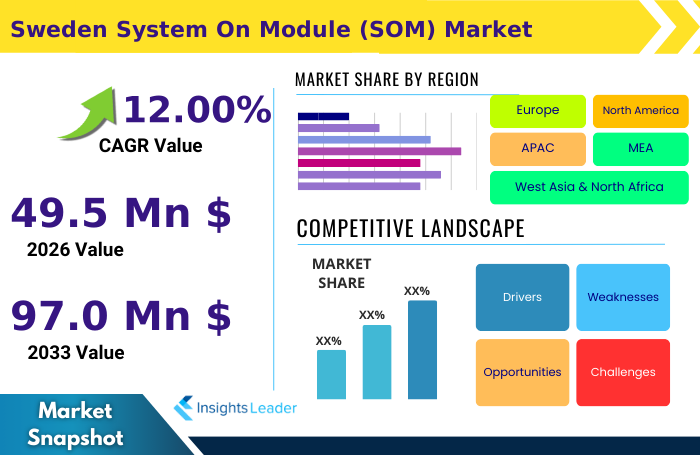
The Sweden System On Module (SOM) Market Size in 2026 is estimated to be $49.5 Million
What is the Growth Rate (CAGR) of Sweden System On Module (SOM) Market?
The Sweden System On Module (SOM) Market is expected to grow at 12.0% CAGR
What is the Market Size of the Sweden System On Module (SOM) in 2033?
The Sweden System On Module (SOM) Market Size in 2033 is estimated to be $97.0 Million
What are DRO & Impact Forces?
Drivers, Restraints, and Opportunities (DRO) are fundamental elements dictating market trajectory. Key drivers in the SOM market include rapid adoption of IoT and edge computing across industrial automation and medical devices in Sweden. Restraints often center on high initial development costs for bespoke carrier boards and the complexity of supply chain management for high-performance processors. Opportunities are found in the integration of 5G connectivity and specialized AI acceleration hardware onto SOM platforms, fostering rapid prototyping for next-generation smart systems.
What is Impact of US tariffs?
The primary impact of US tariffs stems from disruptions in the global semiconductor supply chain, as key components used in SOM manufacturing (processors, memory, specific electronic parts) are often sourced globally, resulting in increased procurement costs for Swedish distributors and OEMs. This pressure forces manufacturers to diversify their sourcing strategies, potentially leading to longer lead times and higher final product prices, which can slow adoption in cost-sensitive segments. Furthermore, tariffs influence inventory strategy, prompting companies to hold larger buffer stocks to mitigate future cost volatility and supply risks.
How is AI currently impacting industries globally?
AI is fundamentally transforming global industries by accelerating the demand for localized, high-performance computing capabilities at the network edge, driven by applications such as real-time predictive maintenance, autonomous robotics, and advanced machine vision systems. This shift necessitates specialized hardware, making SOMs with integrated Neural Processing Units (NPUs) or powerful GPUs essential for deploying sophisticated machine learning models outside of traditional cloud infrastructure. Consequently, industries like manufacturing, healthcare, and automotive are rapidly adopting embedded AI solutions to enhance operational efficiency, improve decision-making speed, and enable highly customized user experiences, fundamentally changing how data is processed and utilized across vast networks of connected devices.